Understanding Kirchhoff's Loop Theorem and Black Body Radiation
120 likes | 268 Vues
This article explores Kirchhoff's Loop Theorem and its implications for the emission and absorption of energy in materials with different coefficients. It discusses the fundamental concepts of radiation, including the behavior of black bodies, Stefan's Law, Wien's Displacement Law, and Planck's formula. By examining energy flow, temperature effects on radiation, and the characteristics of cavity radiation, we gain insight into the nature of thermal radiation and its empirical laws. This topic is crucial in understanding thermal equilibrium and energy distribution among modes in materials.


Understanding Kirchhoff's Loop Theorem and Black Body Radiation
E N D
Presentation Transcript
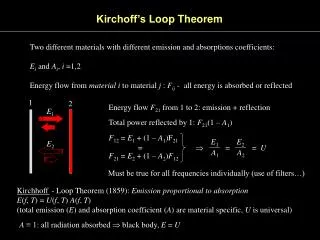
E1 E2 = = U E2 A2 A1 Kirchoff’s Loop Theorem Two different materials with different emission and absorptions coefficients: Ei and Ai, i =1,2 Energy flow from material i to material j : Fij - all energy is absorbed or reflected 1 2 Energy flow F21 from 1 to 2: emission + reflection E1 Total power reflected by 1: F21(1 – A1) F12 = E1 + (1 – A1)F21 = F21 = E2 + (1 – A2)F12 Must be true for all frequencies individually (use of filters…) Kirchhoff - Loop Theorem (1859): Emission proportional to absorption E(f, T) = U(f, T) A(f, T) (total emission (E) and absorption coefficient (A) are material specific, U is universal) A≡ 1: all radiation absorbed black body, E = U
Three Empirical Laws for Black Bodies Stefan’ s Law (1879): Empirical relation between temperature and power radiation per unit area: R = U ( f, T) df/ A= sT4 with the Stefan-Boltzmann constant: s = 5.67×10⁻⁸ W/m²/K4 R depends ONLY on T!!! Wien’s Displacement Law: U ( f, T) has a maximum for a given T: fmax T lmaxT = 2.898×10⁻³ m K For T < 300 °C: no significant emission in visible spectrum, max visible: ~4000 – 7000 K Wien’s Exponential Law: attempt to find a distribution that fulfills both empirical laws (Stefan’s law and Wien’s displacement law) and is in accordance with the general Boltzmann distribution. The proposed distribution is: U ( f, T) = A f ³ exp(-bf/T) Good fit for high frequencies, but fails at low frequencies
a Cavity Radiation Best example for black body: small hole in cavity: Study radiation in cavity, choose simple setup: cubic box with metallic walls; possible radiation: standing waves with nodes at walls nl/2 = a
Cavity Radiation Interaction between waves and walls (absorption and re-emission): distribution of energy among different modes
l = (lx²+ly²) n = (nx²+ ny²) n = (1+9) ly = 2a/3 ny = 3 l = 2a(1/9+1/9) l = 2a(1+1/9) l = 2a(1/4+1/9) n = (1+4) l = 2a(1+1/4) l = 2a(1/4+1/4) ly = 2a/2 ny = 2 l = 2a(1+1) ly= 2a/1 ny = 1 n = (1+1) nx = 1; lx = 2a/1 nx = 2; lx = 2a/2 nx = 3; lx = 2a/3
30 ny = 20 ¼ 2pndn = 31.4 20 ≤ n< 21 (nx²+ny²= n²) ny = 15 ny = 10 ny = 5 ny = 1
Rayleigh Jeans Formula Number of degrees of freedom: N(f) df= 2 ( – 4(–– )3f 2df ) = 2a/n f = c / = n c/2a n = 2a/c f 1 2a 8 c n2dn 2 polarizations number of boxes Energy per degree of freedom: Edof = kT (= Ekin + Epot) Energy density in box: u = Etot /V= Edof Ndof /V = ––––– f 2df 8 kT c3
Planck’s Formula Interpolation between Wien’s exponential law and Rayleigh-Jeans formula: 8 ph f³ 1 c ³ exp(h f /kT) – 1 u(f, T) = with Planck’s constant h = 6.626×10 -34 Js Max-Planck in Stockholm: “But even if the radiation formula proved to be perfectly correct, it would after all have been only an interpolation formula found by lucky guess-work and thus would have left us rather unsatisfied. I therefore strived from the day of its discovery to give it a real physical interpretation and this led me to consider the relations between entropy and probability according to Boltzmann’s ideas. After some weeks of the most intense work of my live, light began to appear to me and unexpected views revealed themselves in the distance.”
E cont. E = kT E = 3kT E cont. Eav = 1.00 kT E = kT Eav = 0.92 kT E = 3kT Eav = 0.50 kT E e–E/kT e–E/kT P(E) = kT kT Understanding Planck’s Formula -- Discrete Boltzmann distribution -- Average energy: (E exp(-E/kT)/kT) dE = kT → S (E exp(-E/kT)/kT)DE - decreases rapidly with step size E = h f S (…) = h f/ (eh f kT– 1)
Planck’s Limited Postulate (first interpretation) The energy of oscillators (electrons) in the wall of the cavity can only assume certain values that are multiples of hn (Planck also derived the factor N(f ) from studying these oscillating electrons). “Act of Desperation” in a letter to R.W. Wood: “I knew that the problem is of fundamental significance for physics; I knew the formula that reproduces the energy distribution in the normal spectrum; a theoretical interpretation had to be found at any cost, no matter how high.”
Black Body Spectrum Clarification: a “Black Body” is an object that absorbs all incident (EM) radiation – but it also emits thermal radiation and depending on the temperature may appear very different from “black”!! Apparent Color 10000 K 1000 K 3000 K 5000 K 7000 K From: http://casswww.ucsd.edu/public/tutorial/Planck.html From: http://www.midnightkite.com/color.html