
Developing Effective Partnerships
E N D
Presentation Transcript
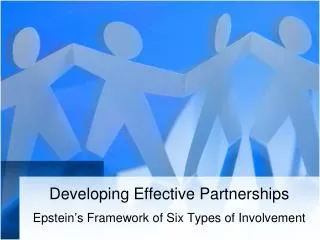
Developing Effective Partnerships Epstein’s Framework of Six Types of Involvement
Why are partnerships important? • The more families support their children’s learning and educational progress, the more their children tend to do well in school and continue their education. • Programs and interventions that engage families in supporting their children’s learning at home are linked to higher student achievement. (Parents’ level of engagement affects the degree of influence). • Teacher outreach to parents is positively related to parent involvement and student achievement. (Henderson & Mapp, 2002)
What are school, family, and community partnerships? School, Family, and Community Partnerships - A philosophy, culture, and process that emphasizes the overlapping influence that stakeholders in each context have on the education and well-being of children and adults.
Epstein’s Framework of 6 Types of Involvement Comprehensive partnership programs have activities that support the following types of involvement:
Type 1 - Parenting • Activities to assist families in: Providing housing, health, nutrition, clothing and safety Developing parenting skills for all age levels Sharing information and activities to help schools understand children and families
Type 2 - Communicating • Information to help families: Understand educational programs and children’s progress Understand student assessments • Opportunities for families to: Express concerns, insights and expectations
Type 3 - Volunteering • Involvement at and for the school or organization: To assist administrators, teachers, students, or parents as mentors, monitors, lecturers, chaperones, tutors, or in other ways To attend assemblies, performances, sports events, ceremonies, and other events
Type 4 – Learning at Home • Involvement in academic activities at home to: Help with and monitor homework Understand skills required to pass/master each subject Guide curriculum-related decisions Support the development of other skills and talents
Type 5 – Decision Making • Family participation in school: Advisory groups Planning committees Program-related decisions
Type 6 – Collaborating with the Community • Connections with the community for needed services, resources, and support • Connections that contribute to the community
Examples of Partnership Activities The National Network of Partnership Schools www. partnershipschools.org or http://www.csos.jhu.edu/p2000/index.htm
Tips for Building Comprehensive Family Engagement Programs • Identify and train a team of administrators, parents, teachers, and other school personnel and community partners to plan, lead the implementation of, and evaluate school wide partnership activities. • Create a welcoming school environment. (See http://education.ohio.gov Search: Family Friendly Partnership) • Provide professional development on family engagement for faculty and staff. (See http://eclkc.ohs.acf.hhs.gov/hslc) • Support families’ sense of efficacy for involvement by providing engagement opportunities that span Epstein’s six types.
Resources • Epstein et al. (2009). School, Family, and Community Partnerships, Your Handbook for Action, Third Edition. Corwin Press. • Henderson, A. & Mapp, K. (2002). A new wave of evidence: The impact of school, family, and community connections on student achievement. Austin, TX: Southwest Educational Development Laboratory. • National Network of Partnership Schools at: www.partnershipschools.org or http://www.csos.jhu.edu/p2000/index.htm • Reynolds, A. & Clements, M. (2005). Parental Involvement and Children’s School Success. In E. Patrikakou, R. Weissberg, S. Redding, & H. Walberg (pp. 109-127), School-Family Partnerships for Children’s Success. NY, NY: Teachers College Press.