Download
1 / 1
10 likes | 135 Vues
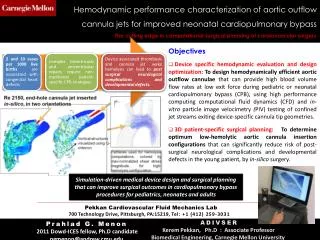
This study focuses on the design and optimization of aortic outflow cannulas using advanced computational fluid dynamics (CFD) and in-vitro particle image velocimetry (PIV). The goal is to create hemodynamically efficient cannulas that deliver high blood volume flow rates with minimal exit force during pediatric and neonatal cardiopulmonary bypass (CPB). By simulating patient-specific surgical plans, we aim to identify configurations that reduce the risk of neurological complications and developmental defects in young patients, enhancing surgical outcomes in cardiovascular procedures.

E N D
Hemodynamic performance characterization of aortic outflow cannula jets for improved neonatal cardiopulmonary bypassThe cutting edge in computational surgical planning of cardiovascular surgery • Objectives • Device specific hemodynamic evaluation and design optimization: To design hemodynamically efficient aortic outflow cannulaethat can provide high blood volume flow rates at low exit force during pediatric or neonatal cardiopulmonary bypass (CPB), using high performance computing computational fluid dynamics (CFD) and in-vitro particle image velocimetry(PIV) testing of confined jet streams exiting device-specific cannula tip geometries. • 3D patient-specific surgical planning: To determine optimum low-hemolytic aortic cannula insertion configurations thatcan significantly reduce risk of post-surgical neurological complications and developmental defects in the young patient, by in-silicosurgery. Simulation-driven medical device design and surgical planning that can improve surgical outcomes in cardiopulmonary bypass procedures for pediatrics, neonates and adults Pekkan Cardiovascular Fluid Mechanics Lab 700 Technology Drive, Pittsburgh, PA:15219, Tel: +1 (412) 259-3031 ADIVSER KeremPekkan, Ph.D : Associate Professor Biomedical Engineering, Carnegie Mellon University Prahlad G. Menon 2011 Dowd-ICES fellow, Ph.D candidate pgmenon@andrew.cmu.edu