Strategies for the Long-term Conservation of Mojave Ground Squirrel Habitat
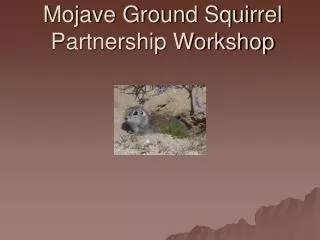
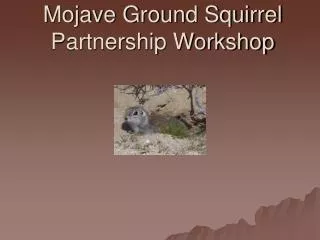
The Mojave Ground Squirrel Partnership Workshop aims to ensure the long-term protection and viability of the Mojave Ground Squirrel (MGS) through a detailed understanding of its range, habitat preferences, and ecological requirements. Key actions include conducting presence/absence surveys, developing adaptive management plans, increasing coordination among stakeholders, and implementing conservation measures to restore and enhance habitats. By prioritizing monitoring and establishing a central database, the workshop seeks to promote effective collaboration and science-based decision-making for the conservation of MGS.

Strategies for the Long-term Conservation of Mojave Ground Squirrel Habitat
E N D
Presentation Transcript
Goal • Ensure long-term protection of MGS habitat & viability of species
1 - Determine the extent of the MGS range • Prioritize areas to be surveyed/monitored to determine presence/absences • Update current MGS map • Fund population biologist/statistician to determine most efficient method of locating MGS • Conduct presence/absence surveys
2 - Determine habitat type • Determine preferred habitat type • Determine ecological requirements
3 - Adaptive management plan • Long term monitoring for status trends • Population estimates and baseline population data • Create and maintain central data base • Standardize data collection techniques • Translocation/ reintroduction of MGS
Adaptive management cont. • Continue to support research that promotes conservation of the species • 1) Locate core populations • 2) Determine important corridors between core areas. • 3) Determine barriers to movement and id measure to minimize barriers • 4) Document genetic variation through out the range
Adaptive management cont. • Assess the need for and develop as necessary education materials that will assist in the conservation of the species.
4) Develop/implement measures to sustain long term viability • Limit the loss of habitat and effects on MGS populations through the application of effective conservation measures and when applicable through mitigation and compensation • 1) Restore and enhancement of habitat • 2) Avoid/minimize impacts to MGS and its habitat
Measures to sustain long term viability cont. • Secure and/or manage sufficient core habitat and corridors to maintain self sustaining populations • Task 1) Develop and implement interim conservation measures • Task 2) Maintain genetic variation through out the range
Foster communication and coordination among participants and other interested parties to identify opportunities for collaborative action to further the acquisition, protection, restoration and management of MGS habitat.
Monitoring Hire a statistician/population biologist Phase I 1) Develop experimental design for presence absence throughout range. 2) Assess method of monitoring for statistical validity, using accepted scientific methods, i.e. Grid vs transects, trapping, vocalization, cameras, etc.
Monitoring cont. Phase II 3) ID aspects of population biology (age specifics, population size, density dependence, survival rate, reproductive rate, sex ratio, etc.) though population viability analysis with simulation models.
Monitoring Phase III Analysis of spatial needs, number of location of core populations and connectivity.