My Simple machines Emma
130 likes | 249 Vues
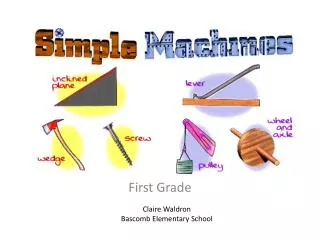
This guide explains the six basic types of simple machines: levers, inclined planes, screws, wedges, wheels and axles, and pulleys. A lever transforms effort into motion using a fulcrum, while an inclined plane reduces the effort needed to elevate objects. Screws function by twisting a ridge, and wedges are used to split or separate materials. The wheel and axle create movement, and pulleys change the direction of force. Each machine exemplifies mechanical advantage, making work easier by efficiently applying force and motion.


My Simple machines Emma
E N D
Presentation Transcript
My Simple machines Emma By: Emma Hardy
Lever Third class lever • A bar which turns on a fixed support called a fulcrum and is used to transmit effort and motion
Inclined Plane • Plank or other plane surface set at an acute angel to a horizontal surface
Screw • Kind of rail with a ridge twisted evenly around its length and often a groove across the head
Wedge • 1 piece of wood or metal tapering to a thin edge, used in splitting, separating , ect. It
Wheel and Axel • Axel on which a wheel is fastened, used to lift weights by winding a rope onto the axel as the wheel is turned
Pulley • 1 wheel with a grooved rim in which a rope can run and so change the direction of a pull
Gear • Wheel that rotates, the wheel has teeth
Machine • 1 arrangement of fixed and moving parts for doing work, each part having some special function
Work • Effort needed to move a certain distance
Force • Energy needed to move a object
Mechanical Advantage • The ratio of resistance or load to the force or effort that is applied in a machine