Advanced GEANT4 Simulations for Gretina: Enhancing Efficiency and Geometry Configurations
160 likes | 287 Vues
This document outlines the use of GEANT4 for simulating Gretina, including geometry setup, efficiency analysis, and the incorporation of scattering materials. Developed by Chris Campbell and supported by INFN, the GretinaSim allows for detailed simulations relevant to fast beam experiments and performance projections for GRETA. Geometry files are available, and the code can be requested. Contributions from summer students and the broader community enhance its capabilities, ensuring precise efficiency evaluations and accurate projections of Gretina's performance.


Advanced GEANT4 Simulations for Gretina: Enhancing Efficiency and Geometry Configurations
E N D
Presentation Transcript
Gretina GEANT simulations Chris Campbell
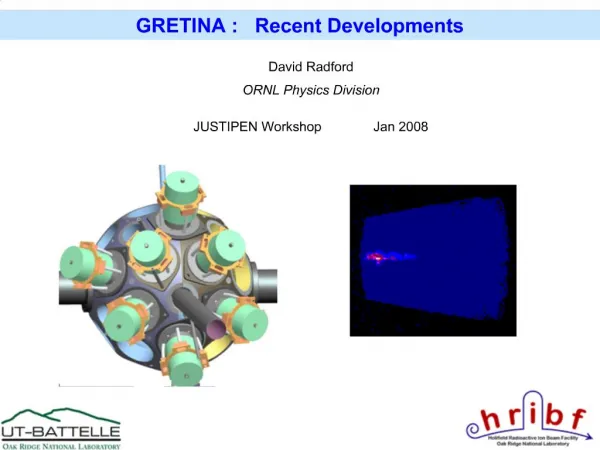
GretinaSim • Using AGATA coded GEANT 4 simulation • INFN (contact: enrico.farnea@pd.infn.it) • http://agata.pd.infn.it/agata_simul.htm • Geometry files setup for Gretina • Convenient startup (minimal configuration) • Geant4 for VMware & VirtualBox • http://geant4.in2p3.fr/spip.php?rubrique8&lang=en • GretinaSim available upon request
Additions from Lew Riley Ursinus College • Summer students: Ben Roberts, Bryan Sadler • Added scattering materials • Gretina mounting hemispheres • Cryostat / dewar block behind crystal • Also checked efficiency effects of • Module walls • Dead layers • Choice of EM interaction in GEANT
UCGRETINA • Gretina geometry was incorporated into a SeGA/Caesar @S800 GEANT simulation • Source distributions appropriate to fast beam experiments • Liquid Hydrogen target added. • Code available on request.
Path forward • Berkeley Lab, as mother institution, serves as repository for the base GretinaSim. This will include geometry additions from the community. • Other tasks: • Understanding of efficiency • Geometry, dead layer, scattering materials • Necessary for accurate projections of Gretina performance (P/T & Effic.) in different configurations. • Also, crucial for credible GRETA projections. • Simulations needed for Decomp (and Tracking) • Basis generation and verification • Number/spacing of interaction positions • Others?