Understanding Thermochemistry: Energy Changes in Chemical Reactions and States
Thermochemistry explores the energy changes during chemical reactions and phase transitions. It focuses on concepts such as chemical potential energy, heat transfer, and the laws governing energy conservation. Key differentiations include heat, which is the total energy from molecular motion depending on size, while temperature indicates average molecular motion, independent of mass. Understanding endothermic and exothermic processes, along with concepts like specific heat and calorimetry, allows for the determination of energy changes in reactions and state changes, essential for applications in chemistry and thermodynamics.

Understanding Thermochemistry: Energy Changes in Chemical Reactions and States
E N D
Presentation Transcript
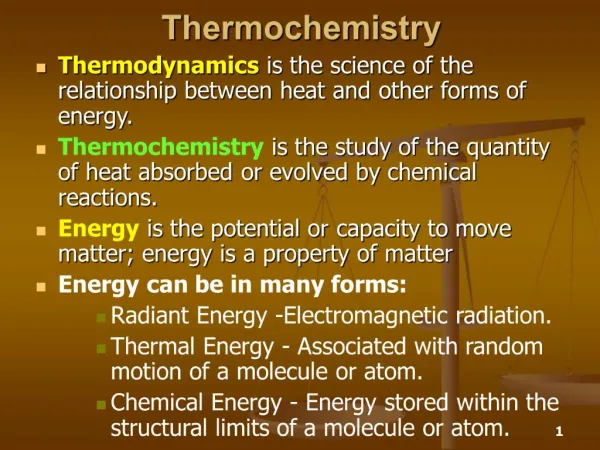
Thermochemistry: Study of energy changes that occur during chemical reactions and changes in state • Chemical Potential Energy: Energy stored in chemical bonds of a substance
What is heat, how does it flow? • Heat (q) : energy transferred from one object to another due to temperature difference • Heat always flows from warmer object to cooler object! Why? Hint – Energy…
Heat vs. Temperature… • Heat: • total energy of molecular motion in a substance • Depends on size and mass • Temperature • average energy of molecular motion in a substance • Does not depend on size or mass • Can one object have more heat, but a lower temperature than another object? • Hot cup of water vs. the ocean
Energy • Law of conservation of energy: Energy is not created or destroyed • Endothermic Process: absorbs heat from the surroundings Reactants + Heat Products • Exothermic Process: releases heat to surroundings Reactants Products + Heat
Units for Heat • calorie: heat needed to raise 1.0 gram of water 1.0ᵒC 1 Calorie = 1 kilocalorie = 1000 calories Ex. Kudos Bar 130 Calories = 130 kcal = 130,000 calories • Joule – SI unit for energy 1 J = 0.2390 cal 4.184 J = 1 cal How many joules are in a Kudos bar?
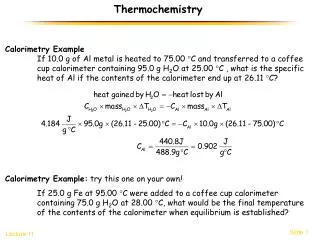
Specific Heat • Specific Heat: Amount of heat needed to increase the temperature of 1g of a substance exactly 1ᵒC. specific heat (C) = Heat (Joules or calories) Mass (grams) x change in temperature (C) C = q . ( m ) (T)
The temperature of a 95.4g piece of copper increases from 25.0ᵒC to 48.0ᵒC when the copper absorbs 849J of heat. What is the specific heat of copper?
Calorimetry • Calorimetry: measure of heat flow into or out of a system • Enthalpy (H): the internal energy of the molecules of a material Heat(q) = H = m (C) T H = change in the heat m = mass C = specific heat T = change in the temperature
Thermochemical Equations • Enthalpy change (ΔH) can be written as a product or a reactant. Endothermic 2NaHCO3(s) +129kJ Na2CO3(s) + H2O(g) + CO2(g) 2NaHCO3(s) Na2CO3(s) + H2O(g) + CO2(g)ΔH=129kJ Exothermic CaO(s) + H2O(l) Ca(OH)2(s) + 65.2 kJ CaO(s) + H2O(l) Ca(OH)2(s)ΔH=-65.2kJ
2NaHCO3(s) + 129kJ Na2CO3(s) + H2O(g) + CO2(g) ΔH=129kJ How much heat (in kJ) is required to decompose 2.24mol of NaHCO3? ΔH = 2.24mol NaHCO3 x 129kJ 2mol NaHCO3 = 144kJ
C2H5OH(l) + 3O2(g) 2CO2(g) + 3H2O(l)ΔH=-1368kJ How much heat (in kJ) is released when 12.5g of ethanol burns?
Fusion and Solidification • Molar Heat of Fusion (ΔHfus): heat absorbed by 1 mol of a substances as it melts (solid liquid) ENDOTHERMIC solid + heat liquid • Molar Heat of Solidification (ΔHsolid): heat lost when 1 mol of a liquid solidifies (liquid solid) EXOTHERMIC liquid solid + heat ΔHfus =-ΔHsolid
Vaporization and Condensation • Molar Heat of Vaporization (ΔHvap): amount of heat needed to convert 1 mol of liquid to gas (liquid gas) ENDOTHERMIC liquid + heat gas • Molar Heat of Condensation: (ΔHcond): amount of heat released when 1 mol of vapor condenses (gas liquid) EXOTHERMIC gas liquid + heat ΔHvap= -ΔHcond
H2O(s) H2O(l) ΔHfus = 6.01kJ/mol How many grams of ice at 0ᵒC will melt if 2.25kJ of heat are added?