Circulation and Immunity
The cardiovascular system, comprising the heart, blood vessels, and blood, is crucial for transporting oxygen, nutrients, and hormones throughout the body, while also defending against disease. It performs four key functions: nutrient delivery, hormonal transport, heat distribution, and immune defense. Cardiac Output, determined by stroke volume and heart rate, is vital for assessing heart health. Average male stroke volume is 70 mL with a resting heart rate of 72 beats/min, leading to a significant daily blood volume pumped. Understanding how heart rate and various factors affect this system is essential for maintaining cardiovascular health.

Circulation and Immunity
E N D
Presentation Transcript
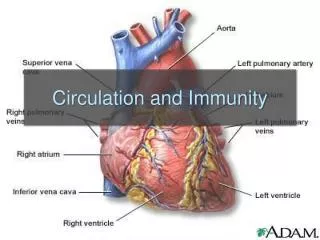
Cardiovascular System • The system consisting of the heart, blood vessels and blood that circulates through the body.
Cardiovascular System • The human circulatory system performs four key functions. • It transports and delivers oxygen and nutrients (e.g. minerals, vitamins, and glucose) to the body’s cells in exchange for carbon dioxide and wastes. • It transports chemical messengers, such as hormones throughout the body. • It distributes heat • It defends against disease
Cardiac Output • Cardiac Output is the volume of blood pumped by the heart in one minute, which is equal to the product of stroke volume and heart rate.
Average Values • The average human male pumps out 70mL of blood per beat (60 mL for females) with an average resting heart rate is around 72 beats per minute.
Example Question • A typical human male has a stroke volume of 70 mL per beat and a resting heart rate of 72 beats per minute. • A. Calculate the cardiac out put. Express your answer in litres per minute. • B. Calculate the volume of blood that would be pumped in one day based upon the cardiac output.
Example Question • A typical human male has a stroke volume of 70 mL per beat and a resting heart rate of 72 beats per minute. • A. Calculate the cardiac out put. Express your answer in litres per minute. • Solution. • Stroke volume = 70 mL/beat • 70 mL x 1/1000mL = 0.070 L/beat
Example Question • A typical human male has a stroke volume of 70 mL per beat and a resting heart rate of 72 beats per minute. • Solution. • Cardiac output (stroke volume)x(heart rate) • =(0.070 L/beat)x 72 (beats/min) = 5.04 L/min • In one day 5.04 L/min x 1440 min/day • = 7257.6 L = 7.3 x 10³ L/day
Heart Beat • Diastole - the phase of the heart’s cycle where a chamber of the heart, either an atrium or a ventricle, relaxes and fills with blood. Semilunar valves closed - “dub” sound produced • Systole - the phase of the heart’s cycle when the ventricles contract to eject blood from within the chamber. AV vales closed - “lub” sound produced.
Factors Affecting Heart Rate • Emotions ie. Fear anxiety • External temperature. Hotter = Higher HR • Activity level. • Age. Older you get the lower your max HR • Fitness level. • Medical conditions.
Target Hear Rate for Exercise • Your maximum heart rate is approximately 220 - your age.