Understanding Weather Prediction: Tools and Techniques Used by Meteorologists
Delve into the world of weather prediction, exploring the role of meteorologists who study weather causes and predictions. Discover essential concepts such as isopleths, isotherms, and isobars, alongside the importance of both simple observations and advanced digital forecasting. Learn about the impact of technology, including weather balloons, satellites, and automated stations, in enhancing forecast accuracy. Understand the distinctions between short-term and long-term forecasting, along with the crucial factors influencing weather patterns and the challenges involved in achieving reliable predictions.

Understanding Weather Prediction: Tools and Techniques Used by Meteorologists
E N D
Presentation Transcript
Vocab • Meteorologist- scientist who study the causes of weather and try to predict it. • Isopleth- connected lines showing equal or similar values • Isotherm = equal temperatures • Isobar= equal barometric pressure
Weather Forecasting • Simple Observations- • Using what we know to deduct what is going to happen • Ex. We know cumulus clouds often form on humid warm afternoons, when these clouds begin to grow taller to cumulonimbus we can deduct there is a storm approaching or forming
Digital forecasting • Interpreting complex data • Meteorologists use maps, charts, and computers to analyze weather data and to prepare weather forecasts. • Different instruments are analyzed for different heights • Balloons, satellites and weather stations
Short term vs long term • Short- involves comparing situations occurring presently to those that occurred recently to picture what will happen in the close future • Too complicated to rely on one area of forecasting • Changes in patterns rely on upper level wind movement • Long- regardless of technology forecasting becomes less reliable due to huge amount of parameters • Accuracy declines greatly over time
Weather Technology • Technological improvements in gathering weather data and using computers have improved accuracy of weather forecasts • Weather Balloons- carry instruments up to the stratosphere
Basic tools • Anemometer- measures wind speed • Hygrometer- measures humidity using a wet and dry bulb. As water evaporates from the wet bulb the temperature between the 2 bulbs changes, we measure this difference
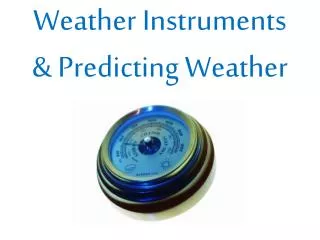
Rain gauge- measures amount of rainfall • Barometer- measures air pressure
Weather Satellites- orbit the earth use camera, thermometers, barometers etc. • Automated weather stations- surface locations that measure a variety of features
Computer forecasts- • Computers gather and process massive amounts of data and arrange it for wide areas and larger time spans