Download
1 / 33
330 likes | 438 Vues
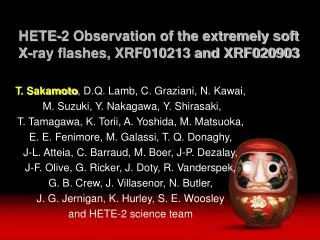
This study explores the observational properties, temporal characteristics, and spectrum of XRF 020903 utilizing data from HETE-2, the French Gamma Telescope (FREGATE), Wide Field X-ray Monitor (WXM), and Soft X-ray Camera (SXC). The analysis reveals unique features of XRF 020903, differentiating it from typical GRBs and confirming its nature as an XRF. The results support the hypothesis that XRFs, X-ray rich GRBs, and GRBs form a continuum of the same phenomenon. The study establishes parameters like the peak energy and spectral characteristics, shedding light on the distinctiveness of XRFs in the high-energy astrophysical landscape.

E N D
HETE- 2OBSERVATIONS OF THE EXTREMELYSOFT X-RAY FLASH XRF 020903 Liang Jau-shian Institute of Physics, NTHU
Introduction The Vela satellites • The discovery of GRB was published in the year 1973.
IPN (Interplanetary Network) • 1980s • Helios 2, Pioneer Venus Orbiter, International Sun-Earth Explorer, Venera 11, Venera 12, the Earth orbiter Prognoz 7
The Compton Gamma-Ray Observatory • April 1991 • The Burst and Transient Source Experiment (BATSE) (10keV ~ MeV)
Observational properties • GRB light curves
Classes of Bursts duration/fluence/spectrum • Long/bright/soft bursts (59%) • Short/faint/hard bursts (23%) • Intermediate (2-5 s)/intermediate/soft busts (18%)
GRB energy spectra • Range: 1keV-18GeV
The Band function Epeak is the energy of the peak of Spectrum.
XRF • no gamma ray counterpart • The XRF spectra are also well described by the Band function.
X-ray rich GRB : Epeak < 50keV • XRF : Epeak at a few keV
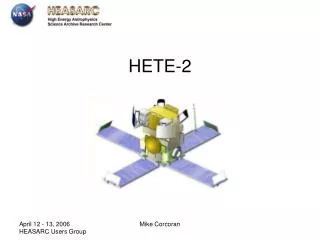
XRF 020903 Observations • HETE-2 • the French Gamma Telescope (FREGATE) • the wide-field X-ray monitor (WXM) • the soft X-ray cameras (SXC)
Temporal properties • Two peaks: 2-5 and 5-10 keV • No significant flux above 10 keV • The duration of the burst is longer in the lower energy band. this trend is similar to long bright GRBs.
The constrained Band function method Result: • Best-fit value Epeak = 2.7 keV • 1.1 keV < Epeak < 3.6keV with 68% probability • Epeak < 5.0 keV with 99.7% probability
Discussion • XRF 020903 is an XRF and not a type I X-ray burst • The observes spectrum of XRF 020903 were not the redshifted spectrum of a typical GRB. • The properties of XRF 020903 are consistent with the relation between S7-30 and S30-400 found by Barraud et al.(2003) • Figures 6-8 provide evidence that XRFs, X-ray rich GRBs, and GRBs from a continuum and are therefore the same phenomenon.