Longitudinal Impact of Diabetes Mellitus on Cardiovascular Health in the Philippines: PhilCOS-DM Study
The Philippine Cardiovascular Outcome Study on Diabetes Mellitus (PhilCOS-DM) highlights an 8-year follow-up, examining the long-term effects of diabetes on cardiovascular health based on the 1998 FNRI National Nutrition Survey. This descriptive cohort study covered Regions NCR, 3, and 4, focusing on the incidence and prevalence of diabetes, impaired fasting glucose (IFG), and impaired glucose tolerance (IGT). Key findings reveal significant rates of diabetes and its complications, emphasizing the importance of ongoing monitoring and intervention in the Filipino population.

Longitudinal Impact of Diabetes Mellitus on Cardiovascular Health in the Philippines: PhilCOS-DM Study
E N D
Presentation Transcript
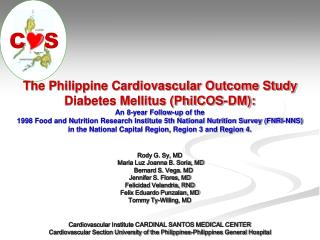
COS The Philippine Cardiovascular Outcome Study Diabetes Mellitus (PhilCOS-DM):An 8-year Follow-up of the 1998 Food and Nutrition Research Institute 5th National Nutrition Survey (FNRI-NNS) in the National Capital Region, Region 3 and Region 4.Rody G. Sy, MDMaria Luz Joanna B. Soria, MD Bernard S. Vega. MDJennifer S. Flores, MDFelicidad Velandria, RNDFelix Eduardo Punzalan, MDTommy Ty-Willing, MDCardiovascular Institute CARDINAL SANTOS MEDICAL CENTERCardiovascular Section University of the Philippines-Philippines General Hospital
Introduction • Diabetes Mellitus is a risk factor for: • Atherosclerosis • Coronary heart disease • Heart Failure
Incidence of Fatal or Nonfatal MI During a 7-Year Follow-up in Relation to History of MI in Nondiabetic vs Diabetic Subjects: East-West Study 45.0 Nondiabetics with prior MI Nondiabetics with no prior MI Diabetics with prior MI Diabetics with no prior MI p<0.001 Incidence During Follow-up (%) 20.2 18.8 P<0.001 3.5 (n=69) (n=1304) (n=169) (n=890) Events per100 person-yr: 3.0 0.5 7.8 3.2 Haffner SM et al. N Engl J Med 1998;339:229-234.
Global Projections for the Diabetes Epidemic: 2000–2025 20.9. 25.8 23% 21.935.8 64% ASIA 102.2 189.4 85% 5.5 11.6 111% 6.9 15.5 120% 1.3 2.2 69% World 2000 = 159 million 2025 = 280 million Increase of 76% Numbers are in Millions Zimmet P et al..
Diabetes in Asia is a Growing Epidemic 20% Prevalence growth Number of People with Diabetes (000) Source: http://www.eatlas.idf.org/prevalence/index (accessed 10/7/2005)
Introduction • 1983 & 1998 prevalence of DM 4% • 2003 NNHeS prevalence of DM 4.6%
PhilCOS-DM In 2006, we attempted the first longitudinal study in the Philippines on some cardiovascular and diabetic outcomes.
COS Objectives A descriptive cohort study to determine: • 8-year incidence rate of diabetes mellitus and impaired fasting glucose (IFG) based on fasting blood glucose (FBG) • prevalence rate of diabetes mellitus, IFG and impaired glucose tolerance (IGT) based on interview, FBG and 2-hours post glucose (2H PG) load, of the NCR, Region 3, and Region 4.
COS Methodology Selection of FNRI-NNS subjects: two-staged stratified sampling design (1998) 8-years follow-up 2006 PhilCOS NCR, n= 345 (73%) Reg3, n= 309 (88%) Reg4, n= 431 (87%) TOTAL = 1085 (82%) 1998 FNRI-NNS NCR, n= 470 Reg3, n= 351 Reg4, n= 495 TOTAL = 1316
COS Methodology 1998 FNRI (N=1316) Unretrieved =18% 2006 revisited (N= 1085) Alive = 913 FBG (N=864) Barangay Health Workers Questionnaire One Touch Ultratm 75 gram glucose load 2h post-glucose load (N=800)
COS Validation of the “One touch glucometer CBG vs FBS-CSMC
COS Criteria for DM, IFG, IGT
COS Data Processing & Analysis • Encoding – Microsoft Access • Analysis – SPSS V12 • Data storage – MS Excel & SPSS V12
COS RESULTS
COS Demographics of the 1998 FNRI-NNS
COS Demographics of the 2006 PhilCOS
COS Prevalence of Diabetes Mellitus based on FBG, 2H PGL, Diabetic Questionnaire, and Combination PhilCOS-DM accepted that the most accurate prevalence rate of Diabetes was the combination of the 3 measures: 18%.
COS - Prevalence of IFG and IGT based on FBG and 2H-PG load
COS The 8-years Incidence of DM using FBG
COS Spectrum of Glucose Homeostasis: From 1998 IFG to DM, IFG and normal in 2006 PhilCOS-DM Among IFGs 48% became diabetics in 8 years.
COS Spectrum of Glucose Homeostasis: From 1998 Normoglucose to DM, IFG and Normal in 2006 PhilCOS-DM The 8-years incidence rate of IFG is 10%.
COS Prevalence of DM using FBG, 2 hour PG, or Combination (n=800) FBG>126 = 9% 2H-PGL>200 = 10% 5% 6% FBG & 2HPG 2HPG alone FBG alone 4% • 2HPG provides better information regarding future risk for CVD… • Elevated 2HPG also predicts the CVD risk in subjects with NORMAL FBG. • Class 1, Level of Evidence A. • ESC and EASD guidelines, 2007
COS Prevalence of IFG, IGT or Combination (n=800) IFG (100-125 mg/dL) = 31% IGT (140-199 mg/dL) = 26% 20% 15% IFG alone IFG & IGT IGT alone 11%
COS Prevalence of IFG, IGT or Combination IGT = 208 IFG = 248 46% 38% IFG alone IFG & IGT IGT alone 16% FBG predicted more pre-diabetics, but a further 38% can be predicted by 2H PG.
COS Limitations of the Study • Use of capillary blood sample • Respondent migration and relocation • Sampling limited to previously generated by the 1998 FNRI-NNS • ? “more urban” cohort • ? “healthier” non-respondents • ? Overestimate of morbidities comparing 2-points in time
COS Conclusions • Incidence rate of DM = 12% • Incidence rate of IFG = 10% • Prevalence rate of DM = 18% • Prevalence rate of IFG = 31% • Prevalence rate of IGT = 26%
COS Awaiting… The PhilCOS Extension Study
COS PhilCOS Extension of the study: • Region 6 - Cebu • Region 10 – Mindanao • Region 5 - Bicol
COS Acknowledgement Sponsors : Philippine Diabetes Association Philippine Lipid and Atherosclerosis Society Philippine Society of Hypertension Therapharma, Inc. Pfizer Phils., Inc. Johnson & Johnson Research Assistants : Maryjun Rangel and Armand Soriano Collaborators : Philippines Diabetes Association key opinion leaders’ forum Special Mention : Municipal Health Officers and Barangay Health workers
PhilCOS DM