Requirement Specification Fall 2005
This lesson focuses on defining requirements in software development using use case methodologies. Participants will learn how to analyze a situation and draft a straightforward requirement specification for a smaller software system. The lesson covers object-oriented techniques and illustrates how to create use case diagrams. Key resources include excerpts from Graig Larman's "Applying UML and Patterns". By the end of this lesson, students will be equipped to understand primary actors, goals, system boundaries, and the context for writing effective use cases.

Requirement Specification Fall 2005
E N D
Presentation Transcript
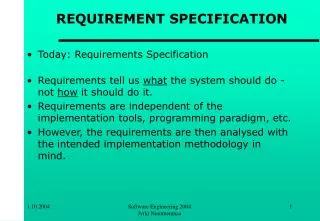
Requirement SpecificationFall 2005 by Eva Trosborg Agenda Requirement definition through use cases
After this lesson you should : • Be able to analyze a given situation and write a simple requirement specification for a smaller software system using object oriented techniques such as use case diagrams
Sources to this lesson • Graig Larman; Applying UML and Patterns Chapter 4 - 7
Fig. 6.1 Scenarie = use case instance = one specific path through the use case Requirements Use Case cover all possible scenario’s p63
Fig. 6.2 Primary actors and goals at different system boundaries p86
Fig. 6.6 Use case diagram (“context diagram”) for Monopoly system p94 Table 6.1 Sample requirements effort across the early iterations; not a recipe p96 Your project??
Fig. 6.7 process and setting context for writing use cases p97
Assignment for the 13. September • Project establishment. Preparing the presentation of the different project roles, Dream group “agreement”. • Slides to be sent to trosborg@itu.dk