Estrus Detection Technologies and Their E conomic I mplications
500 likes | 652 Vues
This paper by K.A. Dolecheck and colleagues from the University of Kentucky explores various estrus detection technologies and their economic impact on dairy farming. It discusses traditional methods' limitations, such as visual observation, and introduces advanced technologies that analyze estrus-associated changes like standing behavior, activity, and rumination. The research offers a user-friendly decision-making tool for farmers, allowing them to compare up to three technologies and assess investment viability through net present value calculations. Understanding these technologies can significantly enhance reproductive performance and improve farm management.


Estrus Detection Technologies and Their E conomic I mplications
E N D
Presentation Transcript
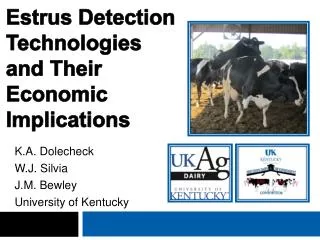
Estrus Detection Technologies and Their Economic Implications K.A. Dolecheck W.J. Silvia J.M. Bewley University of Kentucky
Estrus Detection Methods NAHMS 2007
Visual Observation Problems • Cow problems • Poor footing • Inadequate space • High production • People problems • Time allocation • Accuracy
Technology Opportunities • Estrus associated changes • Secondary signs of estrus • Endocrine signs
Technology Opportunities • Estrus associated changes • Standing behavior
Technology Opportunities • Estrus associated changes • Standing behavior • Secondary signs of estrus • Activity
Activity Estrus
Technology Opportunities • Estrus associated changes • Standing behavior • Secondary signs of estrus • Activity • Rumination
Rumination Estrus
Technology Opportunities • Estrus associated changes • Standing behavior • Secondary signs of estrus • Activity • Rumination • Body temperature • Rectal • Vaginal • Reticular • Tympanic
Vaginal Temperature Temperature Time
Technology Opportunities • Estrus associated changes • Standing behavior • Secondary signs of estrus • Activity • Rumination • Body temperature • Endocrine signs • Progesterone levels
OVULATION 93 +/- 11h 31 +/- 8h Progesterone ONSET 24 +/- 6h LH ESTRUS -4 -3 -2 -1 0
Technology Opportunities • Estrus associated changes • Standing behavior • Secondary signs of estrus • Activity • Rumination • Body temperature • Endocrine signs • Progesterone levels • Other opportunities • Heart rate • Feed intake • Lying vs. standing time • Milk yield • Vaginal conductivity
Herd Dependent • Herd is the biggest factor determining if a system will work • Starting point • Management
Investment Analysis of Automated Estrus Detection Technologies K.A. Dolecheck, G. Heersche Jr., and J.M. Bewley University of Kentucky
Objective • Develop a decision-making tool • User-friendly • Farm-specific • Multiple technologies • Dashboard tools provide interactive interfaces for analysis and decision support
Model Outputs • Reproductive performance • Days open (French and Nebel, 2003) • Investment analysis • Years to break even • Net present value
CalculationsNet Present Value • Present value of cash inflows minus present value of cash outflows • Accounts for timing of revenues and cash flows • Good investment: Net present value ≥ 0 • System net present value determined by considering the value associated with a change in days open
CalculationsOther Considerations • Accounts for costs associated with: • Pre-investment estrus detection method • Semen usage • Pregnancy diagnosis • 10 year investment period
Limitations • Investment analysis does not consider: • Additional benefits of technologies • Changes in heifer inventory • Effect on quality of producer’s life
Tabs organize information Description and instructions for user • Dashboard available at: www2.ca.uky.edu/afsdairy/HeatDetectionTechnologies www2.ca.uky.edu/afsdairy/HeatDetectionTechnologies
Hover buttons explain inputs and results Inputs adjustable in multiple ways • Dashboard available at: www2.ca.uky.edu/afsdairy/HeatDetectionTechnologies www2.ca.uky.edu/afsdairy/HeatDetectionTechnologies
Compare up to 3 different technologies • Dashboard available at: www2.ca.uky.edu/afsdairy/HeatDetectionTechnologies www2.ca.uky.edu/afsdairy/HeatDetectionTechnologies
Technology names appear here Black box and “Best Option” indicate the highest net present value Net present value shown visibly as either good (green) or bad (red) • Dashboard available at: www2.ca.uky.edu/afsdairy/HeatDetectionTechnologies www2.ca.uky.edu/afsdairy/HeatDetectionTechnologies
Example Analysis • Average United States Holstein dairy herd • DairyMetrics (Dairy Records Management Systems, Raleigh, NC, USA) • Food and Agricultural Policy Research Institute (FAPRI; Columbia, MO, USA) • Published literature • Compare high vs. low • Initial investment cost • Cow unit cost • Estrus detection rate
Technology Inputs • Initial investment • $5,000 (Low) • $10,000 (High) • Unit price • $50 (50) • $100 (100) • Estrus detection rate • 70% (70) • 90% (90)
System InputsInitial Costs Low: $5,000 initial investment High: $10,000 initial investment 50: $50 unit price 100: $100 unit price
Other Assumptions • Discount rate = 8.0% (Bewley et al., 2010) • Every animal requires a unit • Replace 5% of units each year
Low: $5,000 initial investment High: $10,000 initial investment 50: $50 unit price 100: $100 unit price 70: 70% estrus detection rate 90: 90% estrus detection rate Analysis ResultsYears to Break Even Investment-Unit Price-EDR
Low: $5,000 initial investment High: $10,000 initial investment 50: $50 unit price 100: $100 unit price 70: 70% estrus detection rate 90: 90% estrus detection rate Analysis ResultsNet Present Value Investment-Unit Price-EDR
Additional AnalysisBreak Even Estrus Detection Rate • Technology estrus detection rates vary under different management situations • Goal: Determine lowest estrus detection rate at which investment in each system is still profitable • Change each system’s estrus detection rate until net present value is equal to $0
Additional AnalysisBreak Even Estrus Detection Rate Investment-Unit Price Low: $5,000 initial investment High: $10,000 initial investment 50: $50 unit price 100: $100 unit price
Additional AnalysisGood Reproductive Management Situation • Investment profitability is dependent on pre-investment reproductive management • Goal: Determine how investment profitability changes with improved beginning estrus detection • 95th percentile = 76%(DairyMetrics)
Additional AnalysisGood Reproductive Management Situation Investment-Unit Price-EDR Technology Example Low: $5,000 initial investment High: $10,000 initial investment 50: $50 unit price 100: $100 unit price 70: 70% estrus detection rate 90: 90% estrus detection rate
Conclusions • Change in days open is affected by estrus detection rate • Years to break even is affected by: • 1) Estrus detection rate • 2) Initial investment cost • 3) Cow unit cost • Net present value is affected by: • 1) Estrus detection rate • 2) Cow unit cost • 3) Initial investment cost
Conclusions • Starting point determines investment profitability • Accurate information is essential for accurate results • Producer • Technology manufacturers • Dairy producers considering purchasing an automated estrus detection technology system can use this model as a decision support tool
Questions? Karmella Dolecheck 411 W.P. Garrigus Building Lexington, KY 40546-0215 208-410-9015 karmella.dolecheck@uky.edu Jeffrey Bewley 407 WP Garrigus Building Lexington, KY 40546 859-257-7543 jbewley@uky.edu • Dashboard available at: • www2.ca.uky.edu/afsdairy/HeatDetectionTechnologies