

SlideServe
Menu
Préférences
© SlideServe · v2026

IP Multi-homing

minjonet avatar
13 diapositives · 326 Views · Sep 24, 2012

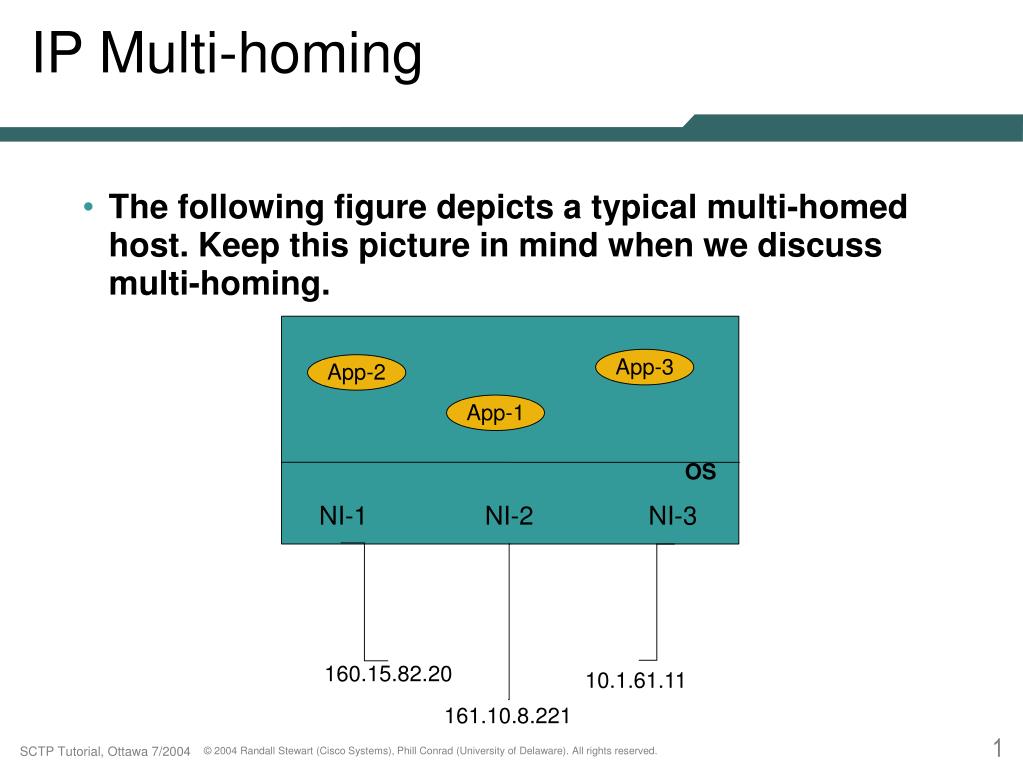
App-3. App-2. App-1. OS. NI-1. NI-2. NI-3. 160.15.82.20. 10.1.61.11. 161.10.8.221. IP Multi-homing. The following figure depicts a typical multi-homed host. Keep this picture in mind when we discuss multi-homing. Endpoint-1. Endpoint-2. NI-1. NI-2. NI-1. NI-2. IP Network.
IP Multi-homing - slide 1
01 / 13IP Multi-homing
1 / 17

Télécharger la présentation

IP Multi-homing
Une image / un lien ci-dessous est fourni (tel quel) pour télécharger la présentation

Politique de téléchargement : le contenu du site vous est fourni TEL QUEL pour votre information et votre usage personnel ; il ne peut être vendu, concédé sous licence ni partagé sur d’autres sites sans l’accord de son auteur.Le contenu vous est fourni TEL QUEL, pour votre information et votre usage personnel uniquement. Téléchargez la présentation en cliquant sur ce lien. Lors du téléchargement, si vous ne parvenez pas à télécharger une présentation, l’éditeur a peut-être supprimé le fichier de son serveur.Pendant le téléchargement, si vous ne parvenez pas à obtenir une présentation, le fichier a peut-être été supprimé par l’éditeur.

F I N

Plus de contenu associé

Transcription de la présentation
  1. App-3 App-2 App-1 OS NI-1 NI-2 NI-3 160.15.82.20 10.1.61.11 161.10.8.221 IP Multi-homing • The following figure depicts a typical multi-homed host. Keep this picture in mind when we discuss multi-homing.

  2. Endpoint-1 Endpoint-2 NI-1 NI-2 NI-1 NI-2 IP Network IP Network Multi-homed Considerations • When a peer is multi-homed, a “primary destination address” is selected by the SCTP endpoint. • By default, all data is sent to this primary address. • When the primary address fails, the sender selects an alternate primary address until it is restored or the user changes the primary address.

  3. Failure Detection and Recovery • SCTP has two methods of detecting fault: • Heartbeats • Data retransmission thresholds • Two types of faults can be discovered: • An unreachable address • An unreachable peer • A destination address may be unreachable due to • interface failure • network failures • endpoint failure

  4. Endpoint-1 Endpoint-2 NI-1 NI-2 NI-1 NI-2 IP Network X IP Network Unreachable Destination Address

  5. Endpoint-1 Endpoint-2 NI-1 NI-2 NI-1 NI-2 IP Network X IP Network X Unreachable Peer: Network Failure

  6. Endpoint-1 Endpoint-2 NI-1 NI-2 NI-1 NI-2 IP Network IP Network Unreachable Peer: Endpoint Failure

  7. Heartbeat Monitoring Mechanism • A HEARTBEAT is sent to any destination address that has been idle for longer than the heartbeat period • A destination address is idle if no chunks that can be used for RTT updates have been sent to it • e.g. usually DATA and HEARTBEAT • The heartbeat period timer is reset any time a DATA or HEARTBEAT are sent • The peer responds with a HEARTBEAT-ACK

  8. Other Uses for Heartbeats • Heartbeat is also used to calculate RTT estimates • The standard Van Jacobson SRTT calculation is done on both DATA RTTs or Heartbeat RTTs • Just after association setup, Heartbeats will occur at a faster rate to “confirm” addresses • Address Confirmation is a new concept added in Version 10 of the I-G

  9. Heartbeat Controls • Heartbeats can be turned on and off. • Heartbeats have a default interval of 30 seconds. This can also be adjusted. • The Error thresholds can be adjusted: • Each Destination's Error threshold • Overall Association Error threshold • Care must be taken in making any adjustments as false failure detections may occur.

  10. Network Diversity and Multi-homing • Multi-homing can assist greatly in preventing single points of failure • Path diversity is also needed to prevent a single point of failure • Consider the following two networks with maximum path diversity and minimal path diversity: • Both hosts are multi-homed, but which network is more desirable?

  11. Endpoint-1 Endpoint-2 Maximum Path Diversity

  12. Endpoint-1 Endpoint-2 Minimum Path Diversity

  13. ADD-IP Extensions • The ADD-IP draft allows dynamic changes to an address set of an endpoint without restart of the association.