### Understanding Invertebrates and Vertebrates: Symmetry, Traits, and Evolution ###
220 likes | 344 Vues
Explore the fascinating world of invertebrates and vertebrates! Learn about the types of symmetry found in sponges and the phyla to which jellyfish belong. Discover unique traits of chordates, from notochords to postanal tails, and delve into the evolution of amphibians and reptiles. Uncover the significance of the circulatory systems in annelids and vertebrates, plus intriguing facts about fish, birds, and mammals. This guide provides a comprehensive overview of animal kingdom diversity and evolution, suitable for all biology enthusiasts. ###


### Understanding Invertebrates and Vertebrates: Symmetry, Traits, and Evolution ###
E N D
Presentation Transcript
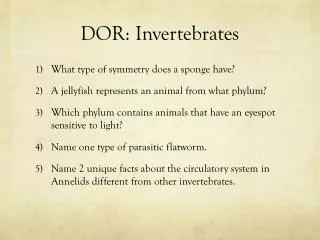
DOR: Invertebrates • What type of symmetry does a sponge have? • A jellyfish represents an animal from what phylum? • Which phylum contains animals that have an eyespot sensitive to light? • Name one type of parasitic flatworm. • Name 2 unique facts about the circulatory system in Annelids different from other invertebrates.
Phylum: Chordates • Traits: • 1) Notochord • Located on the dorsal (“back” side) of the animal • Structural support, vertebral column develops form this structure • 2) Dorsal tubular nerve cord • Nerve cord for developing embrygo • Becomes brain, spinal cord (vertebrates) • 3) Pharyngeal pouches • “temporary” gill slits from most unless fish, amphibian,and nonvertebrate chordates • 4) Postanal tail • Embryonic tail, may not be observed in adult form.
Chordates: Nonvertebrates • Cephalochordates • Ex. Lancelets • Contain all traits of chordates even through adulthood • Provide model for evolutionary and comparative anatomy research • Shallow water, filter feeders • Urochordates • Ex. Sea squirt • Mobile larvae, adult is non-motile/sessile • Does not keep chordate traits to adulthood, only gill slits • Larvae has all chordate traits, bilateral symmetry • Related to vertebrates ?
Vertebrates • Contain traits of chordates AND: • 1) Vertebral column • Notochord becomes individual vertebrae • 2) Skull • Brain protection, skeleton includes this structure with vertebral column • Brain develops specialized region, becomes more complex • 3) Endoskeleton • Animal’s internal skeleton, continual growth (bone marrow) • Made of cartilage/bone • Functions: structural, organ protection, muscle attachment • 4) Internal organs • Well-developed digestive tract, closed circulatory system, respiratory system (gills/lungs), and excretory system
Vertebrates: Fish • Jawless • Ostracoderms: extinct, no fins, filter-feeders • Agnathans: present, skeleton made of cartilage, notochord present, no scales, cyclinder shape (ex. Lampreys, hagfish)
Vertebrates: Fish (cont.) 2) Jawed • Traits: ectotherms (temperature based on environment), gills, closed circulatory system, skeleton with bone or cartilage, SCALES • A) Cartilage • Skeleton composition: cartilage • Dermal denticles—small, rough scales projecting out from animal (ex. Sandpaper) • Ex. Sharks, rays, skates • B) Bony • Ray-finned: most fish, fins have fan shape, variety of feeding styles, SWIM BLADDER • Lobe-finned: fins resemble limbs, can also contain lungs with gills (lungfish), prefer stagnant water
Amphibian Evolution • Evolved from early, jawed fish • Ancient lobe-finned fish adapted to live on land via food resources/predation or advantages • Developed into tetrapods (vertebrates with four limbs, terrestrial)
Vertebrates: Amphibians • Traits: • Tetrapods, contain limbs • No scales, MOIST SKIN • Lungs—small, aided by moist skin • Closed circulatory system with 3-CHAMBER HEART, DOUBLE LOOP • Sensory system with special tongue and eyelids • Dependent on environment’s temperature (ecotherms) • FERTILIZATION in AQUATIC environment, with metamorphosis • Types: • 1) Salamanders/newts—internal fertilization • 2) Frogs/toads • 3) caeilians—no limbs, resemble worms
Vertebrates: Reptiles • Traits: • Limbs occur in pairs—5 toes • THICK/DRY SKIN for water conservation • Lungs well developed • Closed circulatory system with PARTIAL or COMPLETE division of ventricles in heart, DOUBLE LOOP • URIC ACID excretion—water conservation • Ecotherms • AMNIOTIC EGG ! ! ! • Organized based on skull anatomy, no common ancestor (p. 558-559, Fig. 29.15) • Types: • 1) Dinosaurs (ex. T. rex) • 2) Turtles (ex. Box turtle, loggerhead turtle) • 3) Lizards (ex. iguanas, chameleons) • 4) Snakes—Jacobson’s organ, loose jaw attachment to skull (ex. Copperheads, King snake, cottonmouth) • 5) tuatara—pineal eye under skin, resemble lizards • 6) crocodiles/alligators
Reptilian Amniotic Egg • Internal fertilization • Contains protective membranes that fuel embryo’s development via nutrients, oxygen, waste elimination, blood. • Amnion– “fluid sac” where embryo resides and develops until hatching
Vertebrates: “Modified” Reptiles--Birds • HUGE diversity (flying, flightless, beak/behavior/habitat/foot) • Are considered reptiles so have all the traits of reptiles—closely related to crocodiles • Anatomy is built for flight: • Feathers– warmth/insulation, flight and steering, similar to scales • Strong skeleton • Specialized respiratory—lungs have posterior/anterior air sacs, constant gas exchange, aid in body/bone weigh reduction • ENDOTHERMS—regulate their own body temperature • Highly developed sensory system—brain, sight, reflexes, behavior
Vertebrates: Mammals • Traits: • HAIR: isolation, decorative, camouflage • MAMMARY GLANDS: milk production for offspring, female can feed offspring easily without leaving. • Skeleton: BIG brain, differentiation of vertebrae along vertebral column • Closed circulatory, DOUBLE LOOP, 4-CHAMBER HEART • Well-developed nervous system, refined behavior • Offspring develop internally • Types: • 1) Monotremes– contain cloaca, AMNIOTIC EGG (ex. Anteaters, duckbill platypus • 2) Marsupials– “true uterus,” offspring born in uterus and crawl into pouch for continual development (ex. Opossums, koalas, kangaroos) • 3) Placental– main mammal group, offspring develops in uterus, placenta, offspring dependent on parent when born—brain development
Homework • Pp. 568-569, #1-15 “Testing Yourself” • Read Chapter 30