Download
1 / 14
140 likes | 283 Vues
Discover the unique roles of specialized cells in the human body through a hands-on simulation activity. In this lesson, you will learn about various cell types, including neurons, pancreatic cells, muscle cells, and macrophages, each tailored for specific functions such as movement, nutrient absorption, and immune defense. Engage in discussions to analyze specialized organelles, their significance, and the impact of their dysfunction on both the cell and the organism. This activity perfectly blends observation and inquiry to deepen your understanding of cell biology.

E N D
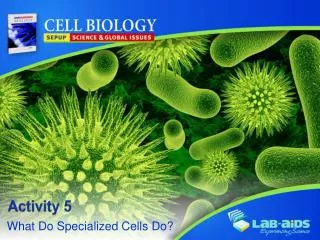
Activity 5 What Do Specialized Cells Do?
What structures do all cells have? • Which type of structure would a cell have more of if it were specialized for movement?
Read the introduction. • Examine the photos of the specialized cells at the bottom of the page. Discuss your observations with your partner.
Challenge • What are the specialized structures and functions of cells?
Follow the directions on Student Sheet 5.1, “Specialized Cells,” to complete the simulation.
Neuron (Nerve Cell) • Sends and receives signals
Pancreatic Cells • Produces and releases insulin to control blood sugar.
Muscle Cell • Causes contractions for movement • Contains lots of mitochondria
Intestinal Cell • Absorbs nutrients from food as it passes through the small intestine. • Villi – increase surface area so it can absorb food more efficiently.
Macrophage (white blood cell) • Digests microbes as part of the immune system
Sperm • Swim to the egg • Mitochondria power the flagellum.
Analysis 1 • Pick two of the specialized cells that you observed in the computer simulation. For each cell: • Pick one specialized organelle or structure and explain its function. • Explain what would happen to the cell if the specialized organelle or structure were damaged or missing. • Explain what would happen to the organism if the specialized organelle or structure were damaged or missing.
Revisit the Challenge • What are the specialized structures and functions of cells?
Key Vocabulary • cell • microbe • organelle