Understanding Adverbs and Interjections: Definitions and Examples
130 likes | 232 Vues
This guide provides a clear explanation of adverbs and interjections, essential components of English grammar. Adverbs modify verbs, adjectives, or other adverbs, answering questions like how, when, or to what extent. Examples include "ran quickly" and "left quietly." Additionally, interjections express emotions and stand alone within sentences, such as "Wow!" or "Ouch!" Learn to distinguish adverbs from adjectives and prepositions with practical examples. Enhance your understanding of these grammatical elements to improve your writing and communication skills.


Understanding Adverbs and Interjections: Definitions and Examples
E N D
Presentation Transcript
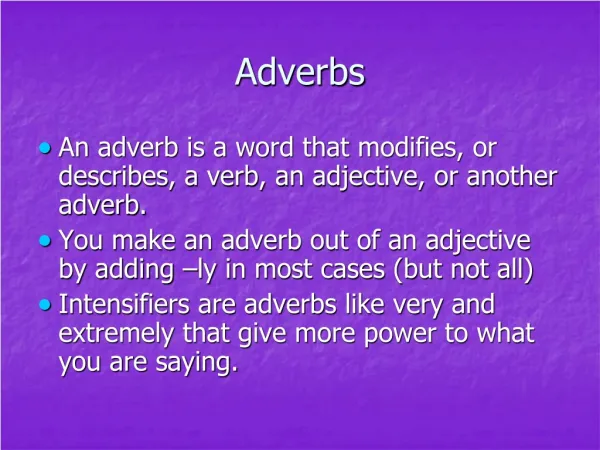
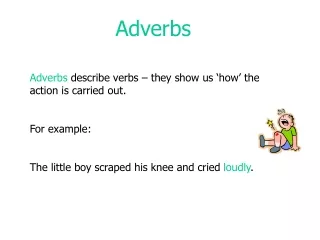
Adverbs Adverbs modify a verb, adjective or another adverb.
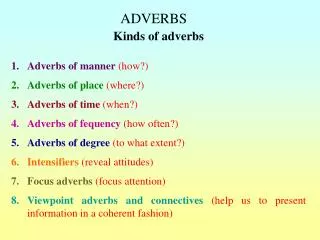
Where?: went outside, sit there When?: left yesterday, never again How?: ranquickly, left quietly To what extent?:very quiet, rather quickly
Don’t confuse adverbs with prepositions! Adverb: I went outside. Preposition: I went outside my house.
Is this an adverb? The baby had curly hair. In this sentence, curly is an adjective. It is describing a noun.
What is the adverb in the following sentence? The three girls quickly finished their homework. A. three B. quickly C. finished D. their
Interjections! An interjection expresses feeling or emotion.
Interjections are independent from the rest of the sentence. They are followed by a comma or an exclamation point.
Examples Ouch! That burns. Wow! This is great! Oh, go away.
Which is the interjection in the following sentence? Wow! You did a great job on your test! A. test B. you C. Wow D. great
The correct answer is C !