Download
1 / 14
140 likes | 275 Vues
Dive into the role of the limbic system and frontal lobe. Explore cases like Phineas Gage and Joel Rifkin to understand brain function and personality changes. Engaging activities and discussions await!

E N D
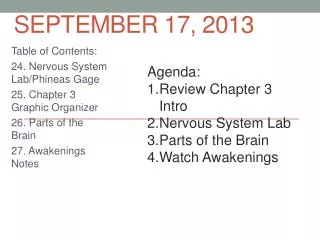
September 17, 2013 Agenda: Review Chapter 3 Intro Nervous System Lab Parts of the Brain Watch Awakenings Table of Contents: 24. Nervous System Lab/Phineas Gage 25. Chapter 3 Graphic Organizer 26. Parts of the Brain 27. Awakenings Notes
Frontal Lobe Summarize our discussion last week of the role of the limbic system and the frontal lobe. • What happened in the frontal lobe of Joel Rifkin? • What happened when Phineas Gage’s frontal lobe was damaged?
Frontal Lobe Video Clips • Phineas Gage- injury to the frontal lobe caused a dramatic personality change • Lobotomy- common psychiatric procedure where the front lobe is intentionally damaged in an attempt to change behavior. Very popular in the US through the 1950’s
Chapter 3 Graphic Organizer Central Nervous System Nervous System Spinal Cord Brain Peripheral Nervous System Hindbrain Midbrain Forebrain
Nervous System Lab- How easy is it to “trick” your brain? You need: A partner Two “sticks” A rule
Parts of the Brain • Hindbrain • Midbrain • Forebrain
Parts of the Brain BRAINSTEM Heart rate and breathing THALAMUS Relays messages amygdala hippocampus pituitary CEREBELLUM Coordination and balance
Hindbrain • Medulla – vital functions (heart rate, breathing, blood pressure) • Pons – regulates body movement; attention, sleep and alertness • Cerebellum – “little brain”; under cerebrum; balance and coordination
Midbrain • Structures that regulate vision and hearing • R.A.S. (Reticular Activating System) – attention, sleep, and arousal; starts in hindbrain and goes through midbrain to bottom of forebrain
Forebrain • Thalamus – “inner chamber”; relay station and sensory switchboard • Hypothalamus – “under” the thalamus; body regulations – temperature, hunger, thirst, sex • Limbic system – structures involved in memory, learning, emotions, aggression, and fear • Cerebrum – “brain”; 70% of brain’s weight; cortex is Latin for “bark”; HIGHER functions/thinking • Association Areas – part of cerebrum – pulls ALL information together; integrates or associates sensory information with stored information
Hemispheres • Left and Right connected by Corpus Callosum • Right is creative/abstract • Left is logical and language based
Lobes Frontal – motor cortex in back Parietal – sensory cortex in front Occipital – visual cortex Temporal – auditory cortex