Understanding Molecular Geometry and Bond Angles Using VSEPR Theory
This chapter delves into the concepts of molecular geometry and bond angles as described by VSEPR theory. Explore the molecular geometry of hydrogen sulfide, which can be classified as bent. We also examine the bond angles associated with the thiocyanate ion (SCN-), with options including 109.5°, 107°, 180°, 104.5°, and 120°. Diagrams and tables within the chapter provide visual aids to reinforce these concepts, helping students visualize and understand the three-dimensional arrangements of molecules.

Understanding Molecular Geometry and Bond Angles Using VSEPR Theory
E N D
Presentation Transcript
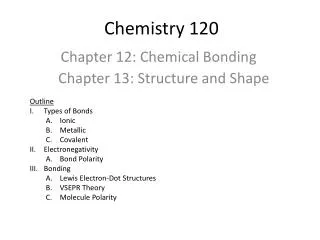
Chemistry 120 Chapter 13: Structure and Shape
Example – VSEPR Theory • What is the molecular geometry for hydrogen sulfide? • tetrahedral • trigonal planar • trigonal pyramidal • bent • linear
Example – VSEPR Theory • What is the bond angle for the thiocyanate ion, SCN-? • 109.5° • 107° • 180° • 104.5° • 120°