Comprehensive Overview of Fundamental Chemistry Concepts and Principles
190 likes | 321 Vues
This review covers essential topics in chemistry, including the molecular vs. particulate view, the scientific method, the periodic table, and properties of elements across various groups. It explores matter and energy principles, chemical nomenclature, and stoichiometry. Additionally, it discusses the atomic theory evolution, chemical bonding, and the behavior of gases, liquids, and solids. With thorough explanations of chemical reactions and acid-base interactions, this review serves as a useful guide for students and educators alike.


Comprehensive Overview of Fundamental Chemistry Concepts and Principles
E N D
Presentation Transcript
Chemistry 120 Review
Chapter 1: Introduction to Chemistry • Molecular vs. Particulate view • Scientific Method
Periodic Table • Names and symbols of elements (1st 56 and Hg, Au, and Pb) • Metals, Nonmetals, Semimetals/Metalloids • Properties • Position on periodic table • Names of groups • Representative/Main group elements • Alkali metals • Alkaline earth metals • Boron group • Carbon group • Nitrogen group • Oxygen/chalcogen group • Halogens • Noble Gases • Transition metals • Inner transition metals • Lanthanides and Actinides
Chapter 2: Matter and Energy • Matter • States of Matter • solid, liquid, and gas • Types of Matter • Pure substance: compounds and elements • Mixture: homogeneous and heterogeneous • Properties of Matter • Chemical and physical changes • Law of Conservation of Mass and Energy
Chapter 3: Measurements and Chemical Calculations • Measurements • Units of Measurement • Metric, USGS, SI • Significant Figures • Dimensional Analysis • Density • Temperature Conversions • ̊̊̊C, ̊F, K ̊C=(5/9) ̊F + 32 and K= ̊C + 273.15
Chapter 5: Atomic Theory: The Nuclear Model of the Atom • Atomic Theory • Dalton’s Atomic Theory • Thomson’s Plum Pudding Model • Subatomic particles: protons and neutrons • Rutherford’s Gold Foil Experiment • Nucleus and electrons • Nuclear Model of the Atom • Planetary Model of the Atom aka Bohr Model • Quantum Mechanical Model of the Atom • Chemical Symbols AZSyc • Mass number = A = number of protons and neutrons • Atomic number = Z = number of protons • Charge = c • Isotopes • Atomic Mass (amu or g/mol)
Chapter 6: Chemical Nomenclature • Nomenclature • Monoatomic ions and polyatomic ions • Ionic • metal nonmetide • metal(r.n) nonmetide • Latin nomenclature using latin roots • higher metal cation charge –ic ending • Lower metal cation charge –ous ending • Molecular • Prefixnonmetalprefixnonmetide • Acids • -ide becomes hydro…ic acid • -ite becomes –ous acid • -ate becomes –ic acid • Hydrates • Metal nonmetideprefixhydrate
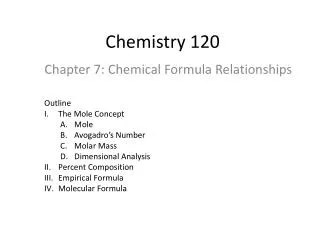
Chapter 7: Chemical Formula Relationships • Mole • Avogadro’s number (1 mol X= 6.022 x 10²³ X) • Molar Mass (g/mol) • Stoichiometry • Using chemical formulas • Percent Composition • Empirical and Molecular Formulas
Chapter 8: Chemical ReactionsChapter 9: Chemical Change • Methods of Writing Chemical Reactions • Conventional Equation • Total Ionic Equation • Net Ionic Equation • Types of Chemical Reactions • Redox • Synthesis/Combination • Decomposition • Single Replacement • Activity Series • Double Replacement (solubility rules) • Precipitation • Gas Evolving • Slightly ionizable substances (water, weak acids and bases) • Acid-base neutralization
Chapter 10: Quantity Relationships in Chemical Reactions • Stoichiometry • Using balanced chemical equations • Calculate the theoretical yield • Calculate percent yield • Limiting Reactant Problems • Thermochemical equations and calculations
Chapter 11: Atomic Theory: The Quantum Model of the Atom • Electromagnetic Spectrum • Pauli Exclusion Principle • Hund’s Rule • Electron Configuration • ns2np6(n-1)d10(n-2)f14 • Periodic Trends • Atomic size • First ionization energy • Metallic character • Electronegativity
Chapter 12: Chemical Bonding • Chemical Bonds • Ionic • Metallic • Covalent • Nonpolar • Polar • Coordinate • Lewis Structures
Chapter 13: Structure and Shape • Valence Shell Electron Pair Repulsion Theory (VSEPR) • Molecule Polarity • Net dipole moments • Exceptions to the octet rule • Organic structures • Hydrocarbons • Alcohols • Ethers • Carboxylic acids
Chapter 4: Introduction to GasesChapter 14: The Ideal Gas Law • Properties of Gases • Kinetic Molecular Theory • STP • 0 ̊C and 760 torr • Molar Volume 22.4 L/mol • Gas Laws • Charles Law: V α T(K) • Boyle’s Law: P α 1/V • Avogadro’s Law: V α n • Ideal Gas Law: PV=nRT • Applications • PV(MM)=mRT • DRT=(MM)P • Molar Volume Mv=V/n or Mv=RT/P • Gas Stoichiometry
Chapter 15: Gases, Liquids and Solids • Dalton’s Law of Partial Pressures: Ptotal= P1 + P2+… • Properties of Liquids • Vapor pressure • Boiling point • Viscosity • Surface tension • Intermolecular Forces • Induced dipole aka London forces or dispersion forces • Dipole forces • Hydrogen bonding • Energy and changes of state q=mc∆T and q=m∆H • Properties of Solids • Amorphous • Crystalline • Ionic • Molecular • Covalent Network • Metallic • Polycrystalline
Chapter 16: Solutions • Types of Solutions • Gas • Solid • Liquid • Units of Concentration • Mass percent • Molarity • Molality • Dilutions M1V1= M2V2 • Solution Stoichiometry
Chapter 17: Acid-Base (Proton Transfer) Reactions • Properties of Acids and Bases • Definitions of Acids and Bases • Arrhenius • Brønsted-Lowry • Lewis • Acid-Base Reactions • Arrhenius acid-base reactions • Brønsted-Lowry acid-base reactions • Lewis acid-base reactions • Single replacement reactions • Metal oxide and acids • Kw, pH and pOH
Lab Techniques • Basic glass working • Proper use of standard equipment • Balances • Electronic and quad-beam • Volumetric equipment • Beakers, graduated cylinders, Erlenmeyer flasks • Volumetric flasks and pipets, burets • Use equipment to collect, organize and evaluate experimental data • Observe physical and chemical changes • Interpret qualitative (non-numerical) and quantitative (numerical) data • Use CRC Handbook to look up information • Make linear graphs using data