Download
1 / 15
150 likes | 278 Vues
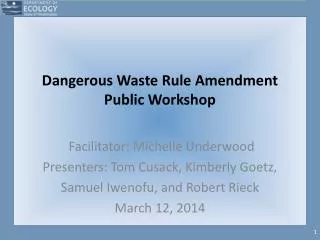
Join us for the Dangerous Waste Rule Amendment workshop held on March 12, 2014, featuring facilitator Michelle Underwood and presenters Tom Cusack, Kimberly Goetz, Samuel Iwenofu, and Robert Rieck. This workshop discusses the rule-making process and the timeline for implementing new EPA rules, including updates on academic lab regulations, import/export rules, and necessary technical corrections. Gain insights into unwanted materials management, requirements for labs, and important financial assurance rules. Your participation is vital for shaping the future of waste management practices.

E N D
Dangerous Waste Rule Amendment Public Workshop Facilitator: Michelle Underwood Presenters: Tom Cusack, Kimberly Goetz, Samuel Iwenofu, and Robert Rieck March 12, 2014
Rule Making Process and Timeline • Sept 2013 – Ecology notice of proposed rule making • Public outreach and informal comments accepted • Aug 2014 – rules changes formally proposed • Public hearing and official comment period • Dec 2014 – Adopt new rules
Overview of Rule Changes • Newer EPA rules: • Academic lab rule • Import/export rule • Technical corrections and clarification • State-initiated rules: • Technical corrections, edits, clarifications • Fuel/water exclusion and financial assurance rules • Revision to Chemical Test Methods Guidance
2008 School Lab Rule • Eligible Labs (Science, art, photo, etc.) • Affects unwanted materials & clean outs • Benefits in counting issues, designation, students • Requirements • Unwanted material removal • Stock rooms • All labs on-site are in or out…not both • Notification, Container regulations, Training • Once waste leaves site, then all RCRA applies • Lab Management Plan to implement the above
Import/Export Rule • Affects OECD countries – foreign policy • For recycling HW, UW and SLABs, not disposal • Adds export regs to SLABs • Creates central EPA office for import/export • Better tracking (exception reports, notification to export & consent, confirmation of recovery) • Better recordkeeping • Prevents unqualified recyclers
RCRA Corrections Rule (Highlights) • Approximately 93 corrections, omissions, and typos • Manifests – rejected loads, exception reports • Scrap metal in Table 1 – better redefines • LDRs apply to recycled materials placed on ground (EPA oversight)
Fuel/Water Exclusion • Fuels contaminated with draw water in tanks at fuel storage tank terminals when the contaminated fuel is to be reclaimed • Draw water: rain/snow/precipitation entering fuel storage tanks unintentionally and mixing with fuel such that the mixture cannot be used as a fuel until the water is removed
Financial Assurance Rules • “Sibling” corporations don’t meet “third-party” cost estimate requirements • “Net Present Value” meaning clarification • Adjust Tangible Net Worth requirement for inflation • “Negative Assurance” reports substitute • Update liability minimums for inflation • Adopt rules for Corrective Action – same as closure/post-closure rules • Fix various typographical errors
Chemical Test Methods (CTM): State-only Persistence Reasons for the change: • CTM guidance - uncertain methods for determining state-only persistence • Guidance contains criterion inconsistent with the Dangerous Waste Regulation • Provide clarity on state-only persistence: total halogenated organic compound vs. total halogen concentrations
Chemical Test Methods Proposed Changes • Streamline the Test Methods : • Limit the suggested test methods to: • EPA SW-846 Test Methods 5050 and 9056 • EPA SW-846 Test Method 9023 • Remove the requirement for individual halogenated organic compound threshold • Update Appendix 5 (Groundwater Monitoring List applicable in Washington State) with the current EPA suggested test methods
Special Waste Rule • Special waste: subset of Dangerous Waste, lower toxicity, lower risk, state-only waste • Proposal: transfer stations limited to 30 days for waste storage • Tie special waste section to definition • Reminder that special waste may be subject to DOT hazardous material requirements
“Independent” Professional Engineers • Many rules require P.E. to certify TSD activities • State requires P.E. to be independent in most cases • Adding the “independent” clause throughout the rules • These changes make this rule consistent throughout regulations
Post-Closure Permit Alternative • Current: contaminated closed sites must obtain RCRA post-closure permit • In lieu of post-closure permit RCRA allows states to use “Enforceable Documents” • MTCA agreed orders is an enforceable document • Clean-up sites with a final Part B permit can’t use enforceable documents
Other Minor Changes • P and U Commercial chemical products – correct errors in state lists to match RCRA • Removal of “Response to requests for public records” rule • Allow electronic submittal of documents submitted to Ecology • Revision of LDR treatment standards for carbamate waste constituents • Clarifications on who can receive off-site dangerous waste
More Questions? Comments? • Provide input via comment form. Find at: http://www.ecy.wa.gov/programs/hwtr/laws_rules/DWRuleMaking.html Contact information: Rob Rieck Phone: (360) 407-6751 Email: rori461@ecy.wa.gov