Download
1 / 16
160 likes | 294 Vues
Explore the fundamentals of angles through the lens of billiards, or pool. Learn to define key terms such as angle, vertex, and congruence, and understand how to measure angles using a protractor. Discover the different types of angles—acute, right, obtuse, and straight—and how to classify them effectively. Engage with practical examples, including bank shots where angles play a crucial role. This comprehensive guide blends geometry with real-world applications, making math engaging and relevant.

E N D
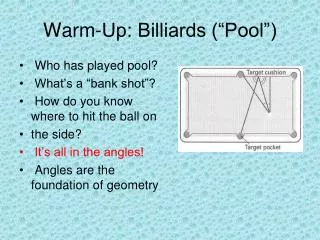
Warm-Up: Billiards (“Pool”) • Who has played pool? • What’s a “bank shot”? • How do you know where to hit the ball on • the side? • It’s all in the angles! • Angles are the foundation of geometry
1.4 Angles & their Measures Objectives: Define: Angle, side, vertex, measure, degree, congruent Name angles with the vertex always in the middle Measure angles with a protractor Identify congruent angles Classify angles as acute, right, obtuse, or straight Add and subtract angle measures using the angle addition postulate
Angle symbol: • 2 rays that share the same endpoint (or initial point) Sides – the rays XY & XZ Vertex – the common endpoint; X Y X 5 Z Named <YXZ, <ZXY (vertex is always in the middle), or <X (if it’s the only <X in the diagram). Angles can also be named by a #. (<5)
In the figure, there are three different <Q’s (two smaller ones and a larger one). therefore, none of them should be called <B. The vertex is ALWAYS in the middle of the name
Example 1: Naming Angles One angle only: < EFG or < GFE Three angles: < ABC or < CBA < CBD or < DBC < ABD or < DBA
Postulate 3: Protractor Post. • The rays of an angle can be matched up with real #s (from 1 to 180) on a protractor so that the measure of the < equals the absolute value of the difference of the 2 #s. 55o 20o m<A = 55-20 = 35o
B is ___________ C is ___________ D is ___________ Interior or Exterior? in the interior in the exterior on the < B C D A
Adjacent Angles • 2 angles that share a common vertex & side, but have no common interior parts. (they have the same vertex, but don’t overlap) such as <1 & <2 2 1
Example 2: m < FJH = m < FJG + m < GJH m < FJH = 35° + 60°
Example 3: . If m<QRP=5xo, m<PRS=2xo, & m<QRS=84o, find x. 5x+2x=84 7x=84 x=12 m<QRP=60o m<PRS=24o S P Q R
Acute angle – Right angle – Obtuse angle – Straight angle – Measures between 0o & 90o Measures exactly 90o Measures between 90o & 180o Measures exactly 180o Types of Angles
Example 4: Classifying Angles • A. straight • B. acute • C. obtuse
Name an acute angle <3, <2, <SBT, or <TBC Name an obtuse angle <ABT Name a right angle <1, <ABS, or <SBC Name a straight angle <ABC Example 5: S T 3 1 2 A B C