Human Population
This document explores key concepts related to human population growth and its environmental implications, including exponential growth models, the demographic transition stages, and factors influencing fertility decline. The Rule of 70 explains population doubling time through growth rates, while the concept of population momentum highlights the effects of age structure on future growth. The relationship between economic factors and fertility decisions is examined, illustrated by case studies like Bangladesh, where fertility rates have significantly decreased despite rising incomes.

Human Population
E N D
Presentation Transcript
Human Population Envi 201 Spring 2004
Key Concepts • Exponential Growth – Rule of 70 • Demographic transition • Age structure and population momentum • Causes of fertility decline • Links between fertility decisions and environment (Dasgupta article)
Exponential Growth • Quantity grows by the same relative amount (g) each year • P(next year) = P(this year)* (1+g) • At time t, P = P0 x (1+g)t
Exponential Growth • Quantity grows by the same relative amount each year • Doubling time d is constant
Rule of 70: • Doubling time x growth rate = 70 • Examples:
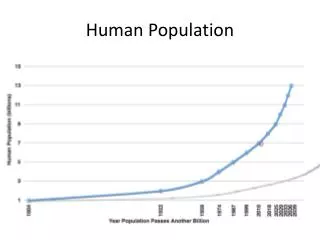
World Population Grew Slowly Through 1945…Then accelerated…Then slowed
Trends in Population Growth Worldwide Population Increase and Growth Rate, Five-Year Periods Percent increase per year Millions Source: United Nations, World Population Prospects: The 2002 Revision (medium scenario), 2003.
Alaska Population: Average Annual Rates of Growth (due to births, deaths, and net migration)
The Demographic Transition • Stage I: high birthrates and death rates • Stage II: continued high birthrates, declining death rates • Stage III: falling birthrates and death rates, eventually stabilizing
Population Momentum • Lots of young people • Although each woman may have total fertility = 2 children, • There are many more future mothers than current mothers
Does Alaska have Population Momentum? Native Age Structure
Testing the Relationship: • Bangladesh fertility dropped from 7.0 to 3.8 between 1970 and 1998 • Bangladesh income per capita in 1998 is supposed to be $2200 in 1980$…. • Latest HDR says $1602 year 2000$ • Fertility has dropped faster than curve predicts