

SlideServe
Menu
Préférences
© SlideServe · v2026

Face Recognition

mirit avatar
19 diapositives · 511 Views · Sep 12, 2014

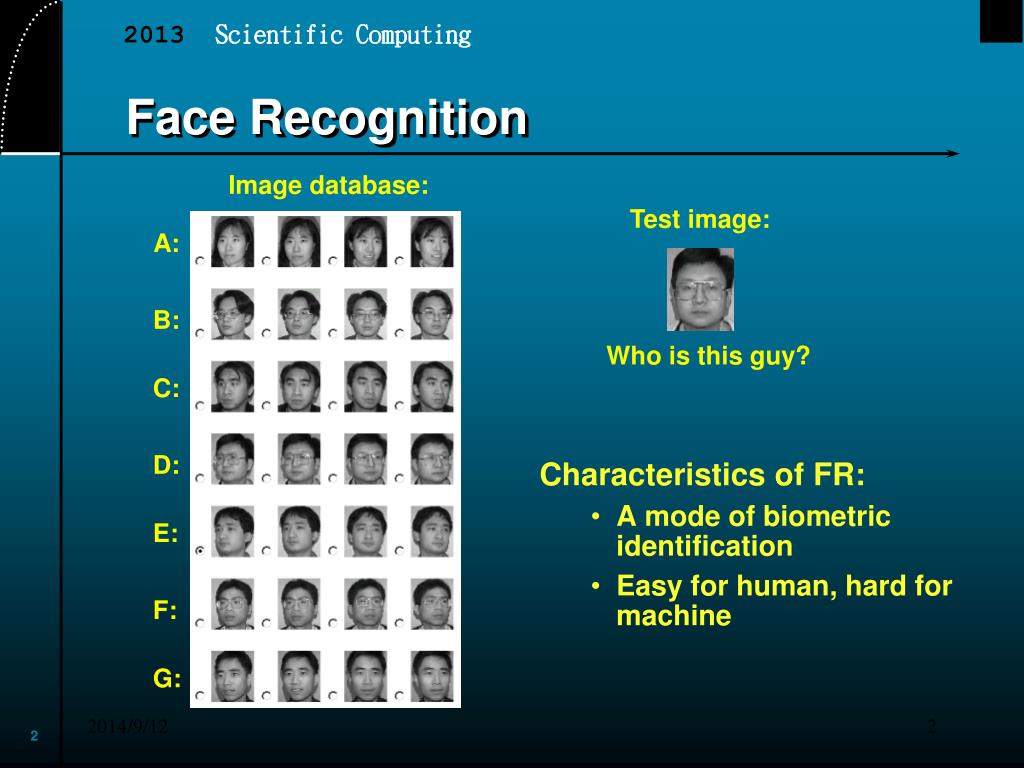
Characteristics of FR: A mode of biometric identification Easy for human, hard for machine. Face Recognition. Image database:. Test image:. A:. B:. Who is this guy?. C:. D:. E:. F:. G:. Biometric Identification. Identification of people from their physical characteristics, such as
Face Recognition - slide 1
01 / 19Face Recognition
1 / 17

Télécharger la présentation

Face Recognition
Une image / un lien ci-dessous est fourni (tel quel) pour télécharger la présentation

Politique de téléchargement : le contenu du site vous est fourni TEL QUEL pour votre information et votre usage personnel ; il ne peut être vendu, concédé sous licence ni partagé sur d’autres sites sans l’accord de son auteur.Le contenu vous est fourni TEL QUEL, pour votre information et votre usage personnel uniquement. Téléchargez la présentation en cliquant sur ce lien. Lors du téléchargement, si vous ne parvenez pas à télécharger une présentation, l’éditeur a peut-être supprimé le fichier de son serveur.Pendant le téléchargement, si vous ne parvenez pas à obtenir une présentation, le fichier a peut-être été supprimé par l’éditeur.

F I N

Plus de contenu associé

Transcription de la présentation
  1. Characteristics of FR: A mode of biometric identification Easy for human, hard for machine Face Recognition Image database: Test image: A: B: Who is this guy? C: D: E: F: G:

  2. Biometric Identification • Identification of people from their physical characteristics, such as • faces • voices • fingerprints • palm prints • hand vein distributions • hand shapes and sizes • retinal scans

  3. FR via PCA • First paper: • M. Turk and A. Pentland, "Eigenfaces for Recognition", Journal of Cognitive Neuroscience, vol. 3, no. 1, pp. 71-86, 1991 • Characteristics • Efficient computation • Proven mathematics • Applicable to face detection

  4. Problem Definition • Input • A dataset of face images of n person • An unknown person’s face image • Output: • Determine the identity of the unknown person

  5. ATT Face Dataset • Origin • Olivetti Research Laboratory, 1992~1994 • Stats: • 40 subjects, each with 10 images • Characteristics • Same-size photos of black and white • Centered faces of different poses

  6. Compute Mean Face Select 6 Principal Eigenfaces Facial Signatures Compute Eigenvectors (Eigenfaces) Face Recognition via PCA Subtract 400 400 400

  7. Steps of Feature Extraction via PCA • 3 simple steps: • Data preprocessing • Each sample image is rearranged into a column vector of length 112*92=10304. All images are put into a matrix F of size 10304x400. • Mean face is subtracted from each column. • PCA • Find the eigenvectors of F*F’. • Projection • Select top k eigenvectors with k largest eigenvalues  k eigenfaces! • Do projection along these eigenfaces to find new features for classification

  8. Details for Step 2: PCA • Problem: is large,10304x10304! (849MB!) How to compute the eigenvectors of ? • Observation: • If u is the eigenvector of F’F, then Fu is the eigenvector of FF’. • If l is the eigenvalue of F’F, then l is also the eigenvalue of FF’. • Note that: • FF’ has 10304 eigenvalues. • F’F has 400 eigenvalues, corresponding to the 400 largest eigenvalues of FF’.

  9. Details for Step 3: Projection (1/2) • Each face (minus the mean) in the training set can be represented as a linear combination of the best k eigenvectors: • Typical eigenfaces when k=4:

  10. Details for Step 3: Projection (2/2) • Since is an orthonormal basis, any face (after mean subtraction) can be represented by this basis: • The feature vector of the face is then the new coordinates obtained by:

  11. Classification • Once the features for images are extracted, we can then apply any classification methods to obtain the final recognition results, including • Minimum distance classifier • Support vector machines • Neural networks • Quadratic classifier • Gaussian mixture models

  12. Face Detection Using Eigenfaces

  13. Distance from Face Space (DFFS)

  14. PCA for ATT Dataset • Variance vs. no. of eigenvalues used • 16 eigenfaces

  15. PCA for ATT Dataset: Accuracy Accuracy vs. no. of eigenvalues used  Accuracy of 98.50% is achieved when the dimensionality is 28.

  16. PCA for ATT Dataset: DFFS

  17. PCA for ATT Dataset: Similarity

  18. PCA for ATT Dataset: Demo load faceData.mat frOpt.method='pca'; frOpt.pcaDim=7; frOpt.plot=1; faceRecogDemo(faceData, frOpt); Face Recognition via PCA (eigenfaces)

  19. PCA+LDA for FR • Steps for FR via fisherfaces: • Perform PCA to reduce to 60 dimensions • Perform LDA to find the best dimensionality  99.00% when the dimensionality is 14.