Download
1 / 10
100 likes | 260 Vues
This work by Enrique V. Zepeda delves into the formation of the first galaxies following the Big Bang, highlighting density fluctuations and challenges to existing theories. Two primary hypotheses for the formation of disk galaxies are explored: the "top-down" theory involving the collapse of gas clouds and the "bottom-up" theory focusing on the merging of dark matter halos. The text addresses observed properties of galaxies such as rotating disks, supermassive black holes, and the significance of gas dynamics, presenting a detailed look at the ongoing debates within cosmology.

E N D
Galaxy Formation by Enrique V. Zepeda 10/01/2012
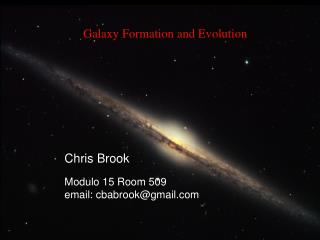
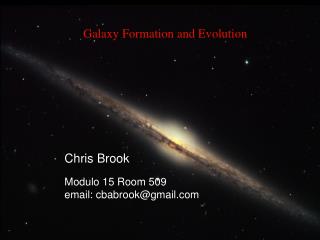
Introduction First galaxies formed due to fluctuations of density in some areas of the early universe. Two theories or the formation of disk galaxies: the first one is that disk galaxies formed due the collapse of a gas cloud. the other one tells that galaxies formed by merging halos of Dark Matter.
Background After the Big Bang, most of the matter thine universe was evenly distributed for sometime. In that state stars and galaxies did not form. But after a few hundreds of millions of years, as the universe started to cool down. Small fluctuations on density in different areas started to appear.
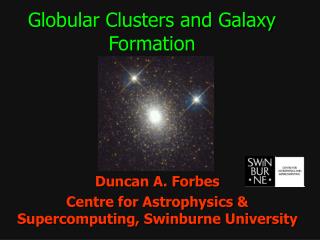
Observed properties of galaxies Thin and fast rotating galaxy disk Halo stars Globular clusters High velocity clouds Supermassive black holes
Formation of disk (spiral) galaxies One theory explains that disks galaxies form by the collapsing of large gas clouds that start spinning faster as the gas is contracting. This is called a "top-down" scenario. However, this theory is not widely accepted because observations of the early universe suggest a "bottom-up" scenario.
Formation of disk (spiral) galaxies (cont'd) Another theory suggest that disk galaxies are formed by the merging of dark matter halos containing protogalaxies. As mass increases the dark matter is distributed to the size while the gas inside contracts into a disk. The problem with this theory is that it does not explai how the contracting gas stops.
References http://en.wikipedia.org/wiki/Galaxy_formation_and_evolution http://onlinelibrary.wiley.com/doi/10.1046/j.1365-8711.2001.04259.x/pdf http://iopscience.iop.org/0004-637X/725/2/2312/pdf/0004-637X_725_2_2312.pdfhttp://www.ncbi.nlm.nih.gov/pmc/articles/PMC34192/pdf/pq000067.pdf