Datagram and Virtual Circuit Network
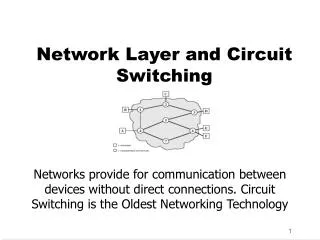
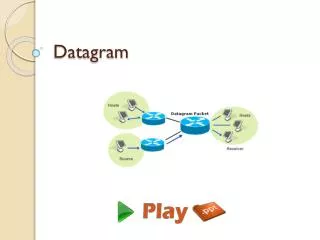
Datagram and Virtual Circuit Network. Datagram Network. Two packets of the same user pair can travel along different routes. The packets can arrive out of sequence . Packets contain full Source, Destination addresses. Requires no connection setup . Datagram. A, B, C, D, E – Users.

Datagram and Virtual Circuit Network
E N D
Presentation Transcript
Datagram Network • Two packets of the same user pair can travel along different routes.
Packets contain full Source, Destination addresses. • Requires no connection setup.
Datagram A, B, C, D, E – Users
Virtual Circuit In a virtual circuit network. • Virtual Circuit(connection setup) is required.
All packets of the same virtual circuit travel along the same path. • Packet sequencing is guaranteed.
Packets contain short Virtual Circuit Id. (VCI). • First packet has large delay.
Terminal Handling • For many applications cost of communication lines exceeds the cost of equipment connected by those lines.
Here we have a terminal controller whichaccepts many input and gives a single output.
Types of configurations • Multidrop • Point to point.
Multidrop • Here all the terminals are wired onto the same multidrop line.
Point to point • Here each terminal has its own point-to- point line to the controller.
Polling • Each terminal has tokeep quiet until the controller says “Go ahead”.
Details of polling differ for the multidrop controller and point-to-point controller.
Multidrop Two methods are common 1. Roll-call polling 2. Hub polling.
Roll-call polling • Controller sends a message to each terminal in turn, inquiring whether or not terminal has anything to say.
These polling messages contain siteaddress or station address identifying which terminal is being addressed. • Each terminal knows its own address and only responds to its own polls, although it receives all the polls.
Hub polling • Here the controller polls the furthest terminal from it.
Point-to-point(Star) • Often uses roll-call polling • It has no site address.
Multiplexer • A multiplexer is a device that accepts input from a collection of lines in some static, predetermined sequence, and outputs the data onto a single output line in the same sequence.
If each terminal operates at 1200 bps, the output line must be 4 X 1200 = 4800 bps.
Routing • Routing is the process of selecting paths in a network.
Step 3 - From 2 determine the next route. • But the distance between nodes1 and 3 is only 9
Shortest route is 1-3-6-5 Distance - 20