Step-by-Step Guide to Finding an Initial Feasible Solution in Flow Networks
This guide outlines a systematic approach to finding an initial feasible solution in flow networks through a series of structured steps. Begin by setting all flows to zero, marking flow members, and identifying feasible paths. The iterative process involves calculating flow increases based on minimum capacities, re-identifying arcs, and repeating the steps until optimal flow is achieved. Each step ensures clarity in marking the sink and selecting paths to incrementally adjust flows. This method is pivotal in solving network flow optimization problems.

Step-by-Step Guide to Finding an Initial Feasible Solution in Flow Networks
E N D
Presentation Transcript
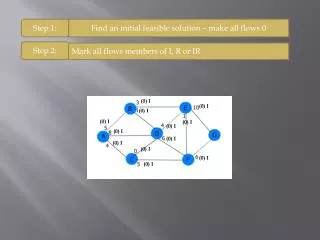
Step 1: Find an initial feasible solution – make all flows 0 Step 2: Mark all flows members of I, R or IR (0) I (0) I (0) I (0) I (0) I (0) I (0) I (0) I (0) I (0) I (0) I (0) I
Step 3: Select any feasible path from A to G (0) I (0) I (0) I (0) I (0) I (0) I (0) I G A (0) I (0) I (0) I C F (0) I (0) I
Step 4: Flow increase = Min (4,5,6) = 4 (0) I (0) I (0) I (0) I (0) I (0) I (0) I G A (0) I (4) I (0) I C F (4) I (4) I
Step 5: Re-identify arcs (0) I (0) I (0) I (0) I (0) I (0) I (0) I G A (0) I (4) R (0) I C F (4) IR (4) IR
Step 6: Repeat from Step 3 •Mark Sink – select A – B – E – F - G •Flow increase = Min (5,3,10,6-4) = 2 (0) I E (0) I B (0) I (0) I (0) I (0) I (0) I G A (0) I (4) R (0) I F (4) IR (4) IR
Re-identify each flow as members of I and R (1) IR E (0) I B (0) I (1) R (1) IR (0) I (0) I G A (0) I (4) R (0) I F (4 + 1) IR (4) IR
Repeat from Step 3 •Mark Sink – select A – D – E – G •Flow increase = Min (8,4,10) = 4 (1) IR E (4) I (0) I (1) R (1) IR (4) I (4) I D G A (0) I (4) R (0) I (4 + 1) IR (4) IR
Re-identify each flow as members of I and R (1) IR E (4) IR (0) I (1) R (1) IR (4) R (4) IR D G A (0) I (4) R (0) I (4 + 1) IR (4) IR
Repeat from Step 3 •Mark Sink – select A – D – F – G •Flow increase = Min (4,6,1) = 1 (1) IR (4) IR (0) I (1) R (1) IR (4) R (4) IR D G A (0) I (4) R (0) I F (5) IR (4) IR
Repeat from Step 3 •Mark Sink – select A – D – F – G •Flow increase = Min (4,6,1) = 1 (1) IR (4) IR (0) I (1) R (1) IR (4) R (4 + 1) IR D G A (1) I (4) R (0) I F (4 + 1 + 1) IR (4) IR
Re-identify each flow as members of I and R (1) IR (4) IR (0) I (1) R (1) IR (4) R (4 + 1) IR D G A (1) IR (4) R (0) I E (6) R (4) IR
Repeat from Step 3 •Mark Sink – select A – B – E – G •Flow increase = Min (5-1,3-1,10-4) = 2 (1) IR E (4) IR B (0) I (1) R (1) IR (4) R (5) IR G A (1) IR (4) R (0) I (6) R (4) IR
Repeat from Step 3 •Mark Sink – select A – B – E – G •Flow increase = Min (5-1,3-1,10-4) = 2 (1+2) IR E (4+2) IR B (0) I (1) R (1+2) IR (4) R (5) IR G A (1) IR (4) R (0) I (6) R (4) IR
Re-identify each flow as members of I and R (3) R E (6) IR B (0) I (1) R (3)IR (4) R (5) IR G A (1) IR (4) R (0) I (6) R (4) IR
(3) R (6) IR (0) I (1) R (3)IR (4) R (5) IR (1) IR (4) R (0) I (6) R (4) IR