Download
1 / 25
250 likes | 376 Vues
This document discusses the vital components of establishing trusted digital repositories, focusing on criteria for certification and the attributes needed to maintain long-term access to digital resources. It outlines the responsibilities of these repositories, including acquisition, preservation, and compliance with the OAIS model, while emphasizing the importance of trust among cultural institutions and their communities. The document also provides recommendations for building a network of trusted repositories and highlights the DINI certificate as a model for certification in Germany and Austria.

E N D
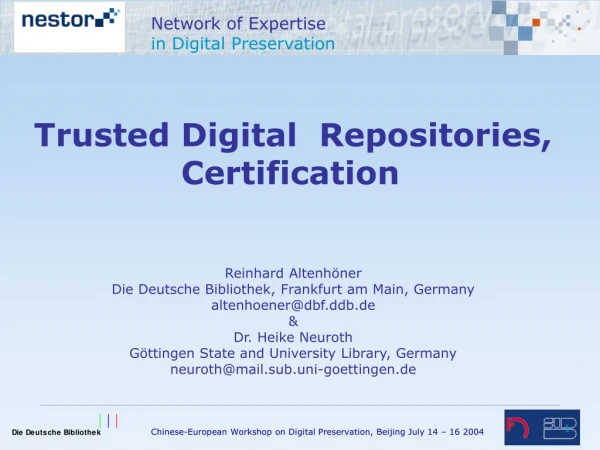
Trusted Digital Repositories, Certification Reinhard Altenhöner Die Deutsche Bibliothek, Frankfurt am Main, Germany altenhoener@dbf.ddb.de & Dr. Heike Neuroth Göttingen State and University Library, Germany neuroth@mail.sub.uni-goettingen.de
Table of Contents • Introduction • Concepts and requirements • Certification criteria • Summary
Definition: trusted digital repository „A trusted repository is one whose mission is to provide reliable, long-term access to managed digital ressources to its designated community, now and in the future.“ „...framework of attributes and responsibilities for trusted repositories...“ (RLG-Group, May 2002)
Requirements for deposit systems http://www.rlg.org/longterm/repositories.pdf
Establishing trust: mayor issues • How cultural institutions earn the trust of their designated communities? • How cultural institutions trust third-party providers? • How users trust the documents provided to them by a repository?
Attributes of a Trusted Digital Repository • Compliance with the OAIS Model • Administrative responsibility • Organizational viability • Financial sustainability • Technological and procedural suitability • System security • Procedural accountability
Responsibilities of a Trusted Digital Repository I • Aquisition • Scope of collections • Preservation and lifecycle management • Range of stakeholders • Ownership / legal issues • Cost implications
Responsibilities of a Trusted Digital Repository II • Operational responsibilities, e.g. • appropriate information from content providers • sufficient control of the information • access methods • authentication and integrity control • support
Recommendations I (general) • Creation of a network / union of trusted digital repositories • Framework / process to support the certification of digital repositories • Models for cooperative repository networks and services
Recommendations II (specific) • Tools to identify the attributes of digital materials that must be preserved • Persistent identification of digital objects (expressly long-term preservation) • Relationship between digital preservation and intellectual property rights • Technical strategies for continuing access to digital media • Minimal-level metadata set to manage digital information for the long term • Automatical generation / extraction of metadata
DINI – Certificate As an Example for Certification of Institutional Repositories in Germany, Austria etc. Could work as a basis for trusted digital repositories? --- Potential criteria are marked with "**"
DeutscheInitiativefürNetzwerkInformation DINI – www.dini.de (German Initiative for Networked Information) • Coalition of German Infrastructure- or Service-Institutions: • Libraries • Computing Centres • Media Centres • Learned Societies
DINI-Certificate • Policy • Author Support • Legal Aspects • Authenticity and Integrity • Indexing • Subject Indexing • Export of Metadata • Interfaces • Logs and Statistics • Long-term Availability http://www.dini.de/zertifikat/dini_certificate.pdf
**Policy • Statements to content • Statements to functional and technical quality • A guarantee to archive for defined time • Definition of services that the operator of the document repository offers to authors and editors
Author support Minimum standard • Offer consultancy services and support via web pages; e-mail, telephone • Support of the entire publication process DINI-recommendations: • Curriculum of courses • Specialized courses on “ structured writing” for authors
**Legal Aspects The operator of the repository must be permitted: • to publish the uploaded document onto the repository • to forward the document to an archiving institution • to alter the documents technically to secure long-term availability • …
**Authenticity and Integrity Minimum technical standards for servers • Documentation of the technical system • Back-up system to secure repository • Technically controlled and verifiable acceptance of documents DINI-recommendations • SSL certification
**Authenticity and Integrity Minimum standards for documents • Persistent Identifier • A document with altered content must be treated as a new document • Archiving of authors uploaded file in their original format DINI-recommendations • Advanced digital signature
Indexing / Subject indexing • Minimum standards • Availability of a defined policy for indexing • Verbal indexing with keywords or classificatory indexing • DINI-OAI-recommendations • At least one additional standardized system • Keywords in English • Abstracts in German and English
**Indexing / Export of Metadata • Minimum standards • Metadata are available for free • Unqualified Dublin Core • DINI-recommendations • Qualified Dublin Core • Technical and/or archival metadata • …
**Indexing / Interfaces • Minimum standards • User interface to the web repository • OAI PMH 2.0 • DINI-recommendations • Expansion to allow for exchange of complex metadata schemata • Web-service interface (e.g. SOAP) • Z 39.50
Logs and Statistics • Minimum standards • Every individual repository must (within legal boundaries) log statistical data on access to the repository and to individual publications • DINI-recommendation • The log containing data on access to a publication should be added to the publication as dynamic metadata
**Long-term Availability • Minimum standards: • Persistent linking of metadata and documents, e.g. via a persistent identifier or storage of metadata and document in container(s) • Definition within the policy of a minimum time span of availability of a document of (no less than five years) • DINI-recommendations: • Securing long-term availability where necessary through cooperation with a archiving institution
Summary • Minimal set of defined criteria for trusted repositories? • Via certification more acceptance (e.g. decision maker, funding agencies etc.)? • International network of trusted repositories? • Registry for trusted repositories? • Exchange of content/metadata between repositories, redundancy? • ...