Young Star PV Ceph Caught Speeding: New Insights into High-Speed Stellar Motion
60 likes | 179 Vues
A team of astrophysicists, including Alyssa A. Goodman from the Harvard-Smithsonian Center for Astrophysics and Héctor G. Arce from Caltech, have presented new findings on a young star, PV Ceph, which has been observed moving at an extraordinary speed of 22 km/s, approximately 3 light years away from its cluster. This discovery is significant as it challenges existing understandings of stellar motion and dynamics. The implications of PV Ceph's high velocity, along with its formation and surrounding molecular outflows, are explored, shedding light on star formation processes.


Young Star PV Ceph Caught Speeding: New Insights into High-Speed Stellar Motion
E N D
Presentation Transcript
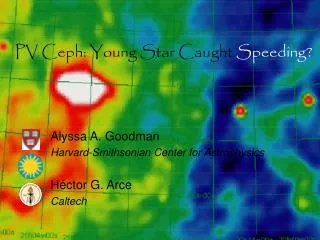
PV Ceph: Young Star Caught Speeding? Alyssa A. Goodman Harvard-Smithsonian Center for Astrophysics Héctor G. Arce Caltech
3 light years “Preponderance of the Evidence” Geometry of the “HH” knots Morphology of Molecular Outflow & Star-Forming “Blob” “Wiggle” of the Jet Goodman & Arce 2004 Figure 1 PV Ceph: The Movie
Simulated Formation of a Star Cluster Bate, Bonnell & Bromm 2002
Optical Image of NGC 7023 Dust Emission Map “Exit wound” NGC 7023 Tom Licha, 2002 PV Ceph Goodman & Arce 2004 Ejected!?
See Furlan et al. 2003? New measurements say no How often does this happen? Direct Proper Motion • RW Aur 16 km s-1, Jones & Herbig 1979 • BN object w.r.t. “I” 50 km s-1, Plambeck et al. 1995 • IRAS 16293-2422 30 km s-1, Loinard 2002 • T-Tau Sb 20 km s-1, Loinard et al. 2003 Deduced from Outflow Morphology • B5 IRS1~10 km s-1, Bally et al. 1996* • Jets in NGC 1333 & Orion clusters ~10 km s-1,Bally & Reipurth 2001* • PV Ceph 20 km s-1, Goodman & Arce 2004 *but the possibility of motion was dismissed, or not emphasized!
Optical Image of NGC 7023 First Evidence for a Young Star moving at such High Speed far from a Cluster Dust Emission Map gap NGC 7023 PV Ceph Tom Licha, 2002 Young StarCaughtSpeeding Away from Home Speed=22 km/s Age=0.5 million years Goodman & Arce 2004