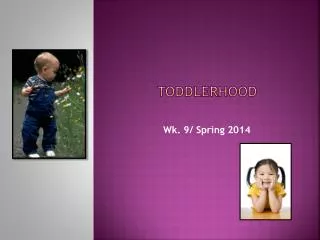
Toddlerhood
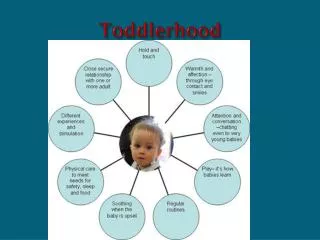
Toddlerhood, spanning from 12 months to 3 years, is a critical phase of growth and development. During this time, growth rates slow to about 3 inches and 4-6 pounds a year, and children's bodies become more proportionate. Key developments include the emergence of gross and fine motor skills, language growth, and the formulation of basic routines for eating, bathing, and dressing. Encouraging autonomy and consistent communication is vital. Additionally, toddlers experience social and moral development while navigating their daily environment. Regular check-ups and safety measures are essential for healthy progress.

Toddlerhood
E N D
Presentation Transcript
Toddlerhood • 12 months to three years • Growth rate slows down • 3 inches a year, 4-6 pounds a year • Body becomes more proportionate • Bones gradually harden or ossify
Two ½ years • Complete set of deciduous teeth • Extremities grow fast (pot belly) • Hearing tests – Eustachian tube shorter • Vital signs begin to slow down • Visit the eye doctor (lazy eye)
Gross Motor Skills • Depends on maturation of muscle, bones, and nerves • Must be ready physically and mentally for new tasks • Balance one one foot, jump with both feet, walk up stairs with both feet, runs
Fine Motor Skills • Ride a tricycle • Puts simple puzzles together • Builds a tower of blocks • Cooies circle or vertical lines • Turns knobs and opens lids (safety?)
The In and Out • Eating • Toileting • Usually more important for parent • Must be able to communicate • By 2 ½ are bladder trained • Handle matter of factly
Daily Skills • Dressing • Communication • Washing • Brushing teeth
Erickson • Autonomy • Independence • Encourage toddlers to make decisions • They still need much guidance • Caregiver needs to be consistent and reinforce limitations
Piaget • Pre-operational thought • Toddlers interpret new experiences based on memories of previous happenings
Moral Development • Occurs as children imitate parent’s moral behavior and teachings
Language Development • Develops along with memory and cognition • Young toddlers use one word sentences • 3 year olds have a vocabulary of 3,000 words and use multiple sentences • Read to child and encourage speech
Nutrition • Well balanced for bone and muscle growth • Portion sizes vary according to child and activity level • Likes and dislikes influenced by family members • Most toddlers like “carry” food • Give food choices, ignore refusals, toddlers like consistency
Sleep • Decreases during this time • Short naps needed • Bedtime rituals help reduce anxiety • Night mares should be handled in a consistent comforting manner
PlayIt is there JOB • Major influence on exploration and understanding of the world • Prefer parallel play • Do not interact or share well • Imaginary playmate common • Tricycles, swings, climbers, rocking horse, color cubes, painting, musical instruments I-pad
Safety • Naturally curious-keep from danger • Continuous supervision • Car safety, road safety, poisonings, burns, choking and suffocation
Doctor Exams • Regular check-ups • 18 months, 24 months, 36 months • See dentist when all deciduous teeth are in
Being the Best • Birth of another child can cause sibling rivalry • Promoting self-esteem • Attend to child’s needs quickly • Spend special time with child • Ignore mishaps • Convey positive regard • Label behavior –NOT CHILD • Positive feedback • Be congruent with communication • If indicated offer an apology