Download
1 / 3
0 likes | 0 Vues
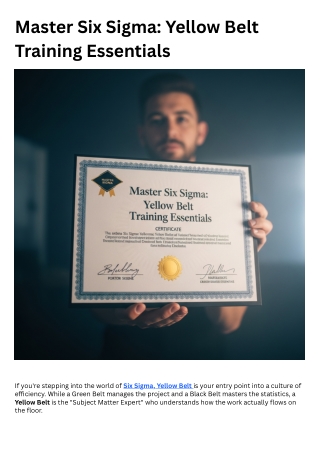
<br>If you're stepping into the world of Six Sigma, Yellow Belt is your entry point into a culture of efficiency. While a Green Belt manages the project and a Black Belt masters the statistics, a Yellow Belt is the "Subject Matter Expert" who understands how the work actually flows on the floor.

E N D
Master Six Sigma: Yellow Belt Training Essentials If you're stepping into the world of Six Sigma, YellowBelt is your entry point into a culture of efficiency. While a Green Belt manages the project and a Black Belt masters the statistics, a Yellow Belt is the "Subject Matter Expert" who understands how the work actually flows on the floor.
To master the essentials, you need to move beyond the definitions and understand how to apply the methodology to real-world problems. 1. The Core Philosophy: Reducing Variation At its heart, Six Sigma is about consistency. If a process takes 5 minutes one day and 45 minutes the next, the process is "broken" even if the average is fine. The Goal: Achieving a process where $99.99966\%$ of all opportunities are defect-free. The Metric: This translates to no more than 3.4 defects per million opportunities (DPMO). 2. The Yellow Belt Toolkit Mastering the belt means knowing which tool to pull from your kit at the right time. Here are the "Essentials" you must know: Visualizing the Process SIPOC (Suppliers, Inputs, Process, Outputs, Customers): Use this at the very start of a project to define boundaries. It prevents "scope creep" by clarifying exactly where the process begins and ends. Value Stream Mapping (VSM): A tool used to identify Value-Added vs. Non-Value-Added steps. If a customer wouldn't pay for a specific step (like waiting for an email), it's waste. Identifying Waste (DOWNTIME) A master Yellow Belt can spot the 8 types of Lean waste instantly using the DOWNTIME acronym: 1. Defects 2. Overproduction 3. Waiting 4. Non-utilized Talent 5. Transportation 6. Inventory 7. Motion 8. Extra-processing 3. Data Collection Essentials You don't need to be a statistician, but you must be a clean data provider. Check Sheets: Create simple, foolproof ways for your team to log errors as they happen. Voice of the Customer (VOC): Always start with what the customer actually wants, not what you think they want. This turns subjective complaints into objective Critical to Quality (CTQ) requirements. 4. The DMAIC Roadmap for Yellow Belts Most Yellow Belt training focuses on supporting the Define, Measure, and Control phases.
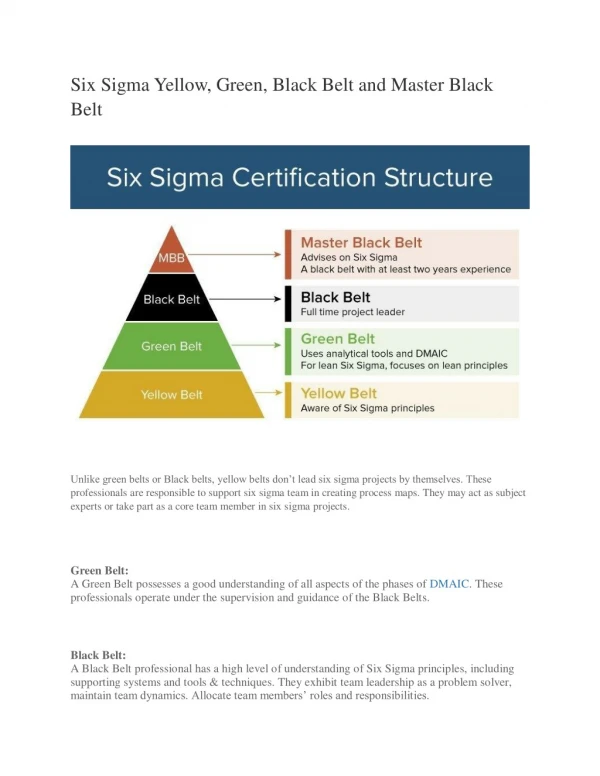
Phase Your Essential Task Define Draft the problem statement. Why does this matter now? Measure Gather baseline data. How bad is the problem today? Analyze Participate in "5 Whys" sessions to find the root cause. Improve Test "Quick Wins" (low-cost, high-impact changes). Control Monitor the new process to ensure people don't slip back into old habits. 5. Tips for Exam & Certification Success If you are studying for a CSSC or ASQ certification: Focus on the "Why": Don't just memorize what a Pareto Chart is; know when to use it (to prioritize the biggest problems). Understand the Roles: Know the hierarchy. Yellow Belts support, Green Belts lead, Black Belts mentor, and Champions provide the resources. Learn the 5S System: Sort, Set in order, Shine, Standardize, and Sustain. It's the easiest way to show immediate improvement in any workspace. Moving Forward Mastering the Yellow Belt is about developing a "Six Sigma Lens"—seeing every delay or error as an opportunity for data-driven improvement rather than a source of frustration.