Addressing Illinois' Fiscal Challenges: Tax Policy Reforms for Education Funding and Economic Equity
410 likes | 533 Vues
This presentation discusses Illinois' fiscal policy issues, focusing on its heavy reliance on property taxes and the impact on education funding. Illinois ranks among the highest states in property tax reliance while providing minimal state funding for education. Proposed reforms, such as SB750, aim to create a progressive tax system, enhance school funding, and address the state's structural budget deficit. With an estimated budget deficit looming, the presentation outlines crucial changes necessary for a fair and sustainable fiscal future.


Addressing Illinois' Fiscal Challenges: Tax Policy Reforms for Education Funding and Economic Equity
E N D
Presentation Transcript
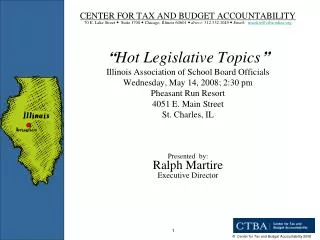
CENTER FOR TAX AND BUDGET ACCOUNTABILITY70 E. Lake Street Suite 1700 Chicago, Illinois 60601 direct: 312.332.1049 Email: rmartire@ctbaonline.org “Hot Legislative Topics” Illinois Association of School Board Officials Wednesday, May 14, 2008; 2:30 pm Pheasant Run Resort 4051 E. Main Street St. Charles, IL Presented by:Ralph MartireExecutive Director
The state’s fiscal policy is the culprit: •The bad attitude of the powers that be is merely icing on the cake TAX POLICY
FIRST, A SNAPSHOT OF WHAT IS Illinois State & Local Revenue • In 2005 (the most recent national comparison available), state and local revenue came from the following sources: PROPERTY TAX 38% SALES TAX 17% EXCISE TAX 17% INDIVIDUAL INCOME TAX 16.2% OTHER 7.4% CORPORATE INCOME TAX 4.4% SOURCE: Federal Tax Administrators Data PROPERTY TAX RELIANCE
This makes Illinois the 6th most reliant state on property tax revenue in the nation. • Two of the states more reliant on property taxes than Illinois – Texas and New Hampshire – do not have income tax. • Illinois is more reliant on property taxes than Florida, Nevada, Tennessee, Alaska, South Dakota, Washington and Wyoming – which also don’t have income taxes. PROPERTY TAX RELIANCE
WHY – EDUCATION • Illinois ranks 49th out of 50 states in the portion of education funding covered by state – versus local – revenue • Illinois is the most reliant state on property taxes to fund schools in the nation. (National Education Association Data) PROPERTY TAX RELIANCE
WHAT SHOULD BE: FAIR PROGRESSIVE RESPONSIVE TO MODERN ECONOMY STABLE DURING POOR ECONOMIES EFFICIENT DOESN’T DISTORT PRIVATE MARKETS ELEMENTS OF A SOUND AND FAIR FISCAL SYSTEM BUT ISN’T
WHICH HAS CONSEQUENCES FOR ANNUAL REVENUE GROWTH $ $ $ $ NEW $$$ ?
THERE ISN’T ANY NOT SO MUCH
The Illinois Structural Deficit (How Revenue Growth Will Not Keep Pace With The Cost of Current Services) $49 Billion Revenue Expenditures $44 Billion $39 Billion $34 Billion $29 Billion $24 Billion 2006 2007 2008 2009 2010 2011 2012 2013 2014 2015 2016 2017 2018 2019 2020 2021 2022 2023 2024 2025 2026 STRUCTURAL DEFICIT *Adjusts solely for historic rates of inflation and population growth, and assumes normal economic growth.
Illinois has the 5th largest population (over 12 million) and economy (about $600 billion annually) in the nation, but • Overall, Illinois’ total state AND local tax burden, as a percentage of personal income ranks only 45th in the nation. • The second lowest tax burden in the Midwest to Missouri. • Illinois taxes 14.8% of income - Missouri 14.7% ILLINOIS IS LOW TAX OVERALL
But Illinois is high tax for low & middle income families • Illinois also ranks only 42nd in spending among the states ILLINOIS IS LOW TAX OVERALL
State & Local Tax Burden as a Percentage of Income REGRESSIVE
Income Growth in the United States 1979-1999 (Real 1999 Dollars) *Source U.S. Census Data 100% 93.4% Percent Change 80% 60% 50.20% 33.20% 40% 20% 5% 0% -20% -6% Next 20% Top 20% Top 15% Top 1% Bottom 60% INCOME INEQUALITY
Shares of U.S. Household Income by Quintiles (1980 & 2005) HOUSEHOLD INCOME Shares of Household Income by Quintiles - 2006
Ignoring all that—here’s the 2008 lottery proposal summary • Sell or lease 80 % of the Illinois Lottery for $10 billion • Use $7 billion to fund a capital program, and float another $3.8 billion in capital bonds • Use $3 billion to purchase an education funding annuity 2008 LOTTERY
The Annuity Fund • Create an annuity fund with the $3 billion balance • Combined with the retained state interest, will generate $600 million in annual revenue stream to fund education over the next 25 years • Intended to replace current Lottery $$$ ILLINOIS LOTTERY
What’s Missing? • Funding Equity/Property Tax Relief • Higher Education • Sustainability • Growth • Cliff ILLINOIS LOTTERY
And that’s a best case scenario • Just 2 years ago, full sale of lottery was to generate $10 billion • Starting point is $22 million less than 2007 lottery proceeds to CSF—over $622 million • Over the last 5 years, lottery revenue has grown by an average of $27 million per year • That’s $108 million in lost revenue over 4 years—& what happens when annuity goes? ILLINOIS LOTTERY
SB750 is designed to: • Be sound tax policy for the modern, capitalist economy • Make tax burden fairer, by making it more progressive―the bottom 60% of income earners won’t pay more in taxes after SB750 passes • Improve school funding by • Raising the foundation level • Enhancing special education funding • Targeting $300M in additional funds to struggling schools • Investing $300M more per year in higher education • Eliminate the Unfunded Pension Liability • Provide progressive property tax relief statewide, that effectively helps struggling communities while reducing fixed costs for business • Keep Illinois’ status as a low tax state SB750
After SB750: • Flat payments of $3.4 billion per year amortize the full unfunded liability • The ramp goes away, out year payments become easier • Normal cost handled by current revenue REFORM
INCOME TAX INCREASE 3% 5% 3% 2% = 5% 2/3 = 67% *Note, corporate rate goes up from 4.8% to 8%, but―overall corporate tax burden goes down! SB750
Brings stability by taxing solely consumer services, like bowling, lawn care and health clubs • SB750- DOES NOT TAX healthcare, housing or business services SB750
Compare that to a Gross Receipts Tax Lumber Company Finishing Company Furniture Manufacturer Wholesaler Retailer Tax Tax Tax Tax TAX GRT's are regressive & inefficient Consumer
Current Basis for Foundation Level • The Illinois state “Foundation Level” is the minimum per child guaranteed expenditure for K-12 • Does NOT include: poverty, special ed, transportation, etc. • Currently $5,734 – but not tied to any measurable standard K-12 FUNDING
Education Funding Advisory Board (“EFAB”) • Change basis to a measurable outcome standard, predicated on costs and test results • Foundation Level should be at least $7,191 (after adjusting for inflation) • Total cost: $1.8 billion EFAB
SPECIAL EDUCATION FUNDING(Not so Special) • $8,000 was granted in 1985 per special ed instructor • Increased in FY 2008 to $9,000 per special ed instructor • Adjusting for inflation, in 2008 a school district would need either $15,844 (CPI) or $19,767 (ECI) just to stay even SPECIAL ED
For Tax Fairness FAMILY TAX CREDIT SUMMARY: $900 million refundable credit targeted to middle, low and no income families Designed to eliminate impact of tax enhancements under SB750 on middle/low income taxpayers Net effect – through refundability feature, the credit effectively relieves both income and sales tax changes, so the bottom 60% of income earners do not pay more in taxes under SB750 EXAMPLE: Tax Credit of $500 Income Tax Liability $200 Balance $300 Taxpayer receives a $300 check for the balance, offsetting sales, excise and property taxes paid. FAIRNESS
PROPERTY TAX RELIEF AMOUNT: $2.9 billion, statewide METHOD: Abatement of 25% of the property taxes that fund education Minimum guaranty of 20%, with extra relief to low income areas TRANSPARENCY: Amount of abatement shown on individual property tax bills DescriptionRiver ForestChicago Heights Total Bill $10,000 $ 6,000 School Levy $ 7,000 $ 4,000 Portion of School Levy ($1,400) ($1,200) already paid by the state 20% minimum 30%, after bonus relief Net Paid by Property Tax Payor $8,600 $4,800 PROPERTY TAX RELIEF
CONTINUING APPROPRIATION A + B + C FY BR $1.8 billion ECI Foundation Level CPI $2.9 billion Property Tax Special Education Mandate, Bonus Investment Pool CONTINUING APPROP.
For More Information: • Center for Tax and Budget Accountability www.ctbaonline.org Ralph M. MartireExecutive Director(312) 332-1049rmartire@ctbaonline.org Chrissy A. ManciniDirector of Budget and Policy Analysis(312) 332-1481cmancini@ctbaonline.org Further Information