Understanding ADHD: Signs, Symptoms, and Effective Strategies for Support
230 likes | 366 Vues
Attention Deficit Hyperactivity Disorder (ADHD) is a neurobehavioral condition marked by persistent inattention and/or hyperactivity-impulsivity, often leading to significant functional impairments. In school settings, students may face challenges such as poor organization, academic underachievement, and behavioral difficulties. Early diagnosis and intervention are crucial. Symptoms must appear before age 7 and present across multiple environments. Comprehensive support includes education, medication, and behavioral management strategies to aid academic and social development.


Understanding ADHD: Signs, Symptoms, and Effective Strategies for Support
E N D
Presentation Transcript
ADHD Presented by: Bridget Connolly Assistant Principal of Student Services Niles North High School
ADHD • Attention Deficit Hyperactivity Disorder is a neurobehavioral disorder characterized by pervasive inattention and/or hyperactivity-impulsivity and resulting in significant functional impairment. • Predominately Inattentive • Hyperactive-Impulsive • Combined Type
How is it Manifested in School • As anadolescent, a student may display any of the following characteristics: • Displays poor organizational skills • Underachieves academically • Exhibits impulsive or risk-taking behavior • Engages in temper outbursts • Sometimes experiences legal difficulties
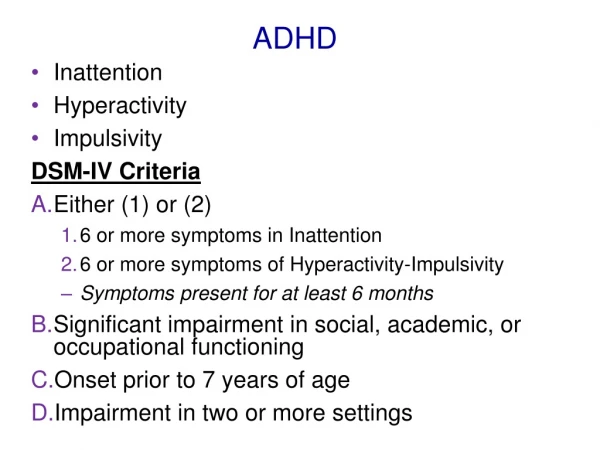
Diagnostic Criteria of ADHD • 6 symptoms of inattention and/or 6 symptoms of hyperactive-impulsive behavior (high frequency) • At least 6-month duration of symptoms • Onset of symptoms before age 7 • Symptoms occur across two or more settings • Symptoms have a significant negative impact on social, academic, or occupational functioning • Another psychiatric disorder (e.g. autism, mood disorder, anxiety disorder, psychotic disorder) is not the primary cause of symptoms
Common Symptoms for ADHD- Predominately Inattentive • Avoids tasks that require sustained attention • Daydreams (tends to stare into space) • Delays initiation or completion of tasks • Has difficulty listening to or following instructions • Does not pay close attention to details • Displays inconsistent academic performance • Forgets or loses materials • Demonstrates a slow speed of cognitive processing
Common Symptoms for ADHD- Hyperactive-Impulsive • Acts before thinking • Begins work before directions are given • Has difficulty delaying gratification • Makes careless mistakes in schoolwork • Does not wait turn in games or activities • Engages in risk-taking/dangerous behavior • Grabs things from others • Interrupts or intrudes on others • Blurts out comments in class
Common Symptoms for ADHD- Hyperactive-Impulsive (cont.) • Runs or climbs excessively • Has difficulty remaining seated • Fidgets with nearby objects • Taps pencil, feet, or fingers • Shifts position in seat frequently • Talks excessively • Experiences rapid changes in mood • Overreacts to negative situations
Prevalence Estimates • ADHD-Predominately Inattentive Type • 1.3% of school-aged children are diagnosed • ratio for boys to girls = 1:1 • ADHD- Hyperactive-Impulsive Type • most children identified are of preschool age • ADHD- Combined Type • 4% of school-aged children are diagnosed • ratio for boys to girls = 3:1
Associated Problems • 80% have achievement problems • 20–40% are diagnosed with learning disabilities (more common with ADHD- Inattentive) • 40% exhibit oppositional behavior in childhood (more common with ADHD- Combined) • 65% exhibit oppositional behavior as adolescents (more common with ADHD- Combined) • 25% engage in antisocial behavior (truancy, physical aggression, stealing- most often ADHD- Combined) • 50% have impaired social relationships • 25% experience comorbid emotional disorders
School-Based Assessment of ADHD Symptoms PURPOSES • To gather information for a potential medical diagnosis • To determine the extent to which attentional problems are interfering with a child’s academic, affective, and social needs • To perform a functional analysis of target behaviors for intervention
Assessment Methods • Parent and teacher interviews • Information should be obtained from multiple adults • Standardized behavior rating scales • Provides a normative perspective to assist in determining symptom severity • Direct observation • Systematic on-task observation and assessment of environmental and instructional variables
Not Proven Effective Interventions • Herbal supplements/vitamins • Biofeedback • Elimination diet (unless there is a sensitivity to food) • Caffeine (may work in short run, but in long run decreases blood flow to brain)
ADHD:What Works--Comprehensive Treatment Approach • Education/Parent Support Groups • Medication • Behavior Management at Home & School • Counseling--Individual & Family • Social Skills Training • School and Home Support Strategies • Physical Activity
ADHD Medications • Stimulants (effective for 70-90%) • Ritalin • Dexedrine • Adderall • Concerta • Cylert
Stimulant Side Effects • Decreased appetite • Weight loss • Growth inhibition • Insomnia/sleep disturbance • Irritability/weepiness • Abdominal pain • Headaches • Dizziness/drowsiness • Tics
Behavior Management • Clear, simple rules & consequences • Consistency • Eliminate emotion, talking/arguing • Giving directions--get attention, be firm, have repeat back to you, give time limits • Visual reminders • Break down assignments and homework • Keep on task with timer, stop-watch
Behavior Management, cont.Encouraging Good Behavior • Immediate Feedback, Frequent Rewards/Incentives & Praise • Frequent Change in Reward (Mystery Motivator) • Immediate Consequences for Selected Behavior (time-out, loss of privilege or points) • Positive Rewards Before Consequences • Plan Ahead for Problems • Priorities--Choose Battles • Don’t Personalize Problems
Behavior Intervention Plans • Describe the target behavior and its severity • Describe the function of the target behavior • Clearly describe the desired positivebehavior • Identify how the environment can be changed to decrease negative behavior • Identify reinforcers to maintain positive behavior • Describe the method for monitoring the behavior plan and who will be responsible
Suggested Classroom Modifications • Assign seating in close proximity to teacher instruction • Provide the student with a study carrel • Give only one or two-step directions at a time • Break assignments down in to smaller segments • Use a timer to monitor/ improve timely work completion • Vary instructional style and incorporate opportunities for active participation • Minimize visual distractions • Ensure a correct match between the difficulty level of the curriculum and the student’s abilities
Key Principles • Provide clear expectations for appropriate behavior • Post classroom rules • Use behavior contracts as needed • Provide specific and frequent verbal feedback • Name the specific behavior that was performed well or should be performed • Make consequences predictable • Use if/then statements • If you continue to …, then… • Provide brief, matter-of-fact redirections
Parents & Teachers Working Together • Communication • Weekly or daily progress reports • Assignment notebooks signed by both • Phone calls/e-mail • Checklists • Homework support • Regular time • Quiet place • Break down assignments/Set timer • Breaks--physical activity • Materials available • Monitor closely & reward good homework behavior • Check assignment books regularly
Concerns • If you have a concern about a student, please contact the student’s guidance counselor. • The student may or may not be eligible to receive additional support and assistance.
Resources • CHADD (Children and Adults with Attention Deficit Disorder) www.chadd.org • ADDA (Attention Deficit Disorder Association) www.add.org • LIDA (Learning Disabilities Association) www.ldanatl.org