Protect Your Baby from Hepatitis B: Essential Prenatal Care and Vaccination Tips
Ensuring your baby’s future health starts with preventing Hepatitis B during pregnancy. Get early prenatal care and be tested for Hepatitis B. Follow your healthcare provider's guidance, and ensure your baby receives all three Hepatitis B vaccinations and the HBIG shot within 12 hours of birth if you are HBV positive. Regular check-ups are essential. Hepatitis B can lead to serious long-term health issues for your child, but vaccination can drastically reduce these risks. Protect your family today!

Protect Your Baby from Hepatitis B: Essential Prenatal Care and Vaccination Tips
E N D
Presentation Transcript
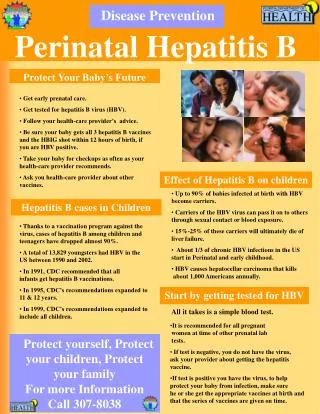
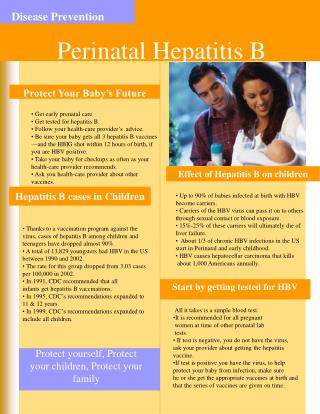
Disease Prevention Perinatal Hepatitis B Protect Your Baby’s Future • Get early prenatal care. • Get tested for hepatitis B. • Follow your health-care provider’s advice. • Be sure your baby gets all 3 hepatitis B vaccines • —and the HBIG shot within 12 hours of birth, if • you are HBV positive. • Take your baby for checkups as often as your • health-care provider recommends. • Ask you health-care provider about other • vaccines. Effect of Hepatitis B on children Hepatitis B cases in Children • Up to 90% of babies infected at birth with HBV • become carriers. • Carriers of the HBV virus can pass it on to others • through sexual contact or blood exposure. • 15%-25% of these carriers will ultimately die of • liver failure. • About 1/3 of chronic HBV infections in the US • start in Perinatal and early childhood. • HBV causes hepatocellar carcinoma that kills • about 1,000 Americans annually. • Thanks to a vaccination program against the • virus, cases of hepatitis B among children and • teenagers have dropped almost 90%. • A total of 13,829 youngsters had HBV in the US • between 1990 and 2002. • The rate for this group dropped from 3.03 cases • per 100,000 in 2002. • In 1991, CDC recommended that all • infants get hepatitis B vaccinations. • In 1995, CDC’s recommendations expanded to • 11 & 12 years. • In 1999, CDC’s recommendations expanded to • include all children. Start by getting tested for HBV • All it takes is a simple blood test. • It is recommended for all pregnant • women at time of other prenatal lab • tests. • If test is negative, you do not have the virus, • ask your provider about getting the hepatitis • vaccine. • If test is positive you have the virus, to help • protect your baby from infection, make sure • he or she get the appropriate vaccines at birth and • that the series of vaccines are given on time. Protect yourself, Protect your children, Protect your family