
Microbial Growth
E N D
Presentation Transcript
Microbial Growth • Growth in Batch Culture • Mean Generation Time and Growth Rate • Measurement of Microbial Growth • Continuous Culture • Factors Influencing Growth • Growth in Natural Environments
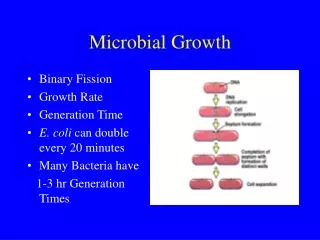
Growth in Batch Culture • “Growth” is generally used to refer to the acquisition of biomass leading to cell division, or reproduction • A “batch culture” is a closed system in broth medium in which no additional nutrient is added after inoculation of the broth.
Growth in Batch Culture • Typically, a batch culture passes through four distinct stages: • Lag stage • Logarithmic (exponential) growth • Stationary stage • Death stage
Mean Generation Timeand Growth Rate • The mean generation time (doubling time) is the amount of time required for the concentration of cells to double during the log stage. It is expressed in units of minutes. • Growth rate (min-1) = • Mean generation time can be determined directly from a semilog plot of bacterial concentration vs time after inoculation
Measurement of Microbial Growth • Microscopic cell counts • Calibrated “Petroff-Hausser counting chamber,” similar to hemacytometer, can be used • Generally very difficult for bacteria since cells tend to move in and out of counting field • Can be useful for organisms that can’t be cultured • Special stains (e.g. serological stains or stains for viable cells) can be used for specific purposes • Serial dilution and colony counting • Also know as “viable cell counts” • Concentrated samples are diluted by serial dilution
Measurement of Microbial Growth • Serial dilution and colony counting • Also know as “viable cell counts” • Concentrated samples are diluted by serial dilution • The diluted samples can be either plated by spread plating or by pour plating
Measurement of Microbial Growth • Serial dilution (cont.) • Diluted samples are spread onto media in petri dishes and incubated • Colonies are counted. The concentration of bacteria in the original sample is calculated (from plates with 25 – 250 colonies, from the FDA Bacteriological Analytical Manual). • A simple calculation, with a single plate falling into the statistically valid range, is given below:
Measurement of Microbial Growth • Serial dilution (cont.) • So you’ve seen all this before, huh? • What if there is more than oneplate in the statistically valid range of 25 – 250 colonies? • For details on this standard method, see:FDA Bacteriological Analytical Manual • and specifically the section on:Aerobic Plate Counts • Really. • heh, heh.
Measurement of Microbial Growth • Where:C = Sum of all colonies on all plates between 25 - 250n1= number of plates counted at dilution 1 (least diluted plate counted)n2= number of plates counted at dilution 2 (dilution 2 = 0.1 of dilution 1)d1= dilution factor of dilution 1V= Volume plated per plate
Measurement of Microbial Growth • Membrane filtration • Used for samples with low microbial concentration • A measured volume (usually 1 to 100 ml) of sample is filtered through a membrane filter (typically with a 0.45 μm pore size) • The filter is placed on a nutrient agar medium and incubated • Colonies grow on the filter and can be counted
Measurement of Microbial Growth • Turbidity • Based on the diffraction or “scattering” of light by bacteria in a broth culture • Light scattering is measured as optical absorbance in a spectrophotometer • Optical absorbance is directly proportional to the concentration of bacteria in the suspension
Measurement of Microbial Growth • Mass determination • Cells are removed from a broth culture by centrifugation and weighed to determine the “wet mass.” • The cells can be dried out and weighed to determine the “dry mass.” • Measurement of enzymatic activity or other cell components
Growth in Continuous Culture • A “continuous culture” is an open system in which fresh media is continuously added to the culture at a constant rate, and old broth is removed at the same rate. • This method is accomplished in a device called a chemostat. • Typically, the concentration of cells will reach an equilibrium level that remains constant as long as the nutrient feed is maintained.
Factors that Influence Growth • Growth vs. Tolerance • “Growth” is generally used to refer to the acquisition of biomass leading to cell division, or reproduction • Many microbes can survive under conditions in which they cannot grow • The suffix “-phile” is often used to describe conditions permitting growth, whereas the term “tolerant” describes conditions in which the organisms survive, but don’t necessarily grow • For example, a “thermophilic bacterium” grows under conditions of elevated temperature, while a “thermotolerant bacterium” survives elevated temperature, but grows at a lower temperature
Factors that Influence Growth • Obligate (strict) vs. facultative • “Obligate” (or “strict”) means that a given condition is required for growth • “Facultative” means that the organism can grow under the condition, but doesn’t require it • The term “facultative” is often applied to sub-optimal conditions • For example, an obligate thermophile requires elevated temperatures for growth, while a facultative thermophile may grow in either elevated temperatures or lower temperatures
Factors that Influence Growth • Temperature • Most bacteria grow throughout a range of approximately 20 Celsius degrees, with the maximum growth rate at a certain “optimum temperature” • Psychrophiles: Grows well at 0ºC; optimally between 0ºC – 15ºC • Psychrotrophs: Can grow at 0 – 10ºC; optimum between 20 – 30ºC and maximum around 35ºC • Mesophiles: Optimum around 20 – 45ºC • Moderate thermophiles: Optimum around 55 – 65 ºC • Extreme thermophiles (Hyperthermophiles): Optimum around 80 – 113 ºC
Factors that Influence Growth • pH • Acidophiles: • Grow optimally between ~pH 0 and 5.5 • Neutrophiles • Growoptimally between pH 5.5 and 8 • Alkalophiles • Grow optimally between pH 8 – 11.5
Factors that Influence Growth • Salt concentration • Halophiles require elevated salt concentrations to grow; often require 0.2 M ionic strength or greater and may some may grow at 1 M or greater; example, Halobacterium • Osmotolerant (halotolerant) organisms grow over a wide range of salt concentrations or ionic strengths; for example, Staphylococcus aureus
Factors that Influence Growth • Oxygen concentration • Strict aerobes: Require oxygen for growth (~20%) • Strict anaerobes: Grow in the absence of oxygen; cannot grow in the presence of oxygen • Facultative anaerobes: Grow best in the presence of oxygen, but are able to grow (at reduced rates) in the absence of oxygen • Aerotolerant anaerobes: Can grow equally well in the presence or absence of oxygen • Microaerophiles: Require reduced concentrations of oxygen (~2 – 10%) for growth
Quorum Sensing • A mechanism by which members of a bacterial population can behave cooperatively, altering their patterns of gene expression (transcription) in response to the density of the population • In this way, the entire population can respond in a manner most strategically practical depending on how sparse or dense the population is.
Quorum Sensing • Mechanism: • As the bacteria in the population grow, they secrete a quorum signaling molecule into the environment (for example, in many gram-negative bacteria the signal is an acyl homoserine lactone, HSL) • When the quorum signal reaches a high enough concentration, it triggers specific receptor proteins that usually act as transcriptional inducers, turning on quorum-sensitive genes