SlideServe
Menu
Préférences
© SlideServe · v2026

Square Roots and Perfect Squares

montana-mcknight avatar
12 diapositives · 207 Views · Nov 13, 2014

Explore the relationship between square roots and perfect squares, learn to find square roots of numbers, and understand the concepts of squaring and taking square roots. Practice examples included.
Square Roots and Perfect Squares - slide 1
01 / 12Square Roots and Perfect Squares
1 / 17

Télécharger la présentation

Square Roots and Perfect Squares
Une image / un lien ci-dessous est fourni (tel quel) pour télécharger la présentation

Politique de téléchargement : le contenu du site vous est fourni TEL QUEL pour votre information et votre usage personnel ; il ne peut être vendu, concédé sous licence ni partagé sur d’autres sites sans l’accord de son auteur.Le contenu vous est fourni TEL QUEL, pour votre information et votre usage personnel uniquement. Téléchargez la présentation en cliquant sur ce lien. Lors du téléchargement, si vous ne parvenez pas à télécharger une présentation, l’éditeur a peut-être supprimé le fichier de son serveur.Pendant le téléchargement, si vous ne parvenez pas à obtenir une présentation, le fichier a peut-être été supprimé par l’éditeur.

F I N

Plus de contenu associé

Transcription de la présentation
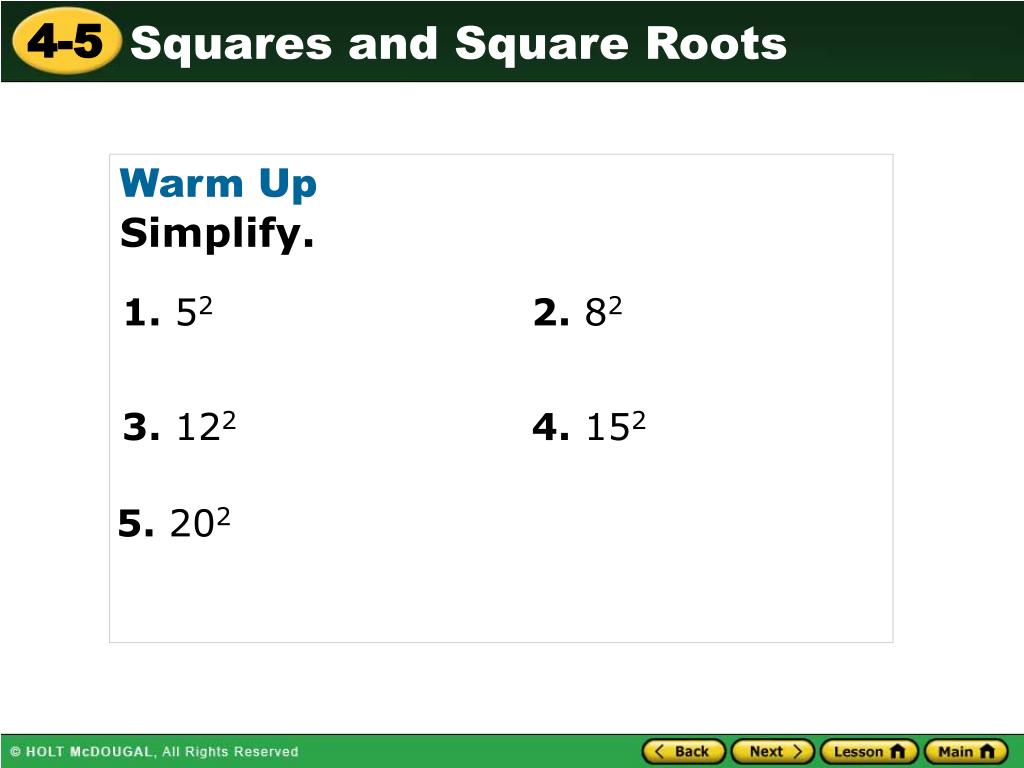
  1. Warm Up Simplify. 1. 522. 82 3. 1224. 152 5. 202

  2. 62 = 36 36 = 6 Think about the relationship between the area of a square and the length of one of its sides. area = 36 square units side length = 6 units because 62=36 A number that when multiplied by itself to form a product is the square rootof that product. Taking the square root of a number is the inverse of squaring the number.

  3. Caution! –49 is not the same as – 49. A negative number has no real square root. Every positive number has two square roots, one positive and one negative. The radical symbol indicates the nonnegative or principal square root. The symbol – is used to indicate the negative square root. The numbers 16, 36, and 49 are examples of perfect squares. A perfect square is a number that has integers as its square roots. Other perfect squares include 1, 4, 9, 25, 64, and 81.

  4. Additional Example: 1 Finding the Positive and Negative Square Roots of a Number Find the two square roots of each number. A. 49 B. 100 C. 225

  5. Check It Out: Example 1 Find the two square roots of each number. A. 81 9 • 9 = 81 81 = (–9)(–9) = 81 = ±9 B. 144 144 = 12 • 12 = 144 (–12)(–12) = 144 = ±12 C. 324 324 = 18 • 18 = 324 (–18)(–18) = 324 = ±18

  6. So 169 = 13. Remember! The area of a square is s2, where s is the length of a side. Additional Example 2: Application A square window has an area of 169 square inches. How wide is the window? Write and solve an equation to find the area of the window. 132 = 169 Use the positive square root; a negative length has no meaning. The window is 13 inches wide.

  7. Check It Out: Example 2 A square window has an area of 225 square inches. How wide is the window?

  8. 3 36 + 7 Additional Example 3A: Evaluating Expressions Involving Square Roots Simplify the expression.

  9. 25 16 3 4 Additional Example 3B: Evaluating Expressions Involving Square Roots Simplify the expression. +

  10. 2 121 + 9 2 121 + 9 = 2(11) + 9 Check It Out: Example 3A Simplify each expression. = 22 + 9 = 31

  11. 16 36 2 3 Check It Out: Example 3B Simplify each expression. +

  12. –5 336 + 25 Check It Out: Example 3C Simplify each expression.