
SlideServe
Menu
Préférences
© SlideServe · v2026

Warm Up Simplify each expression.

jnoriega avatar
24 diapositives · 324 Views · Jan 01, 2020

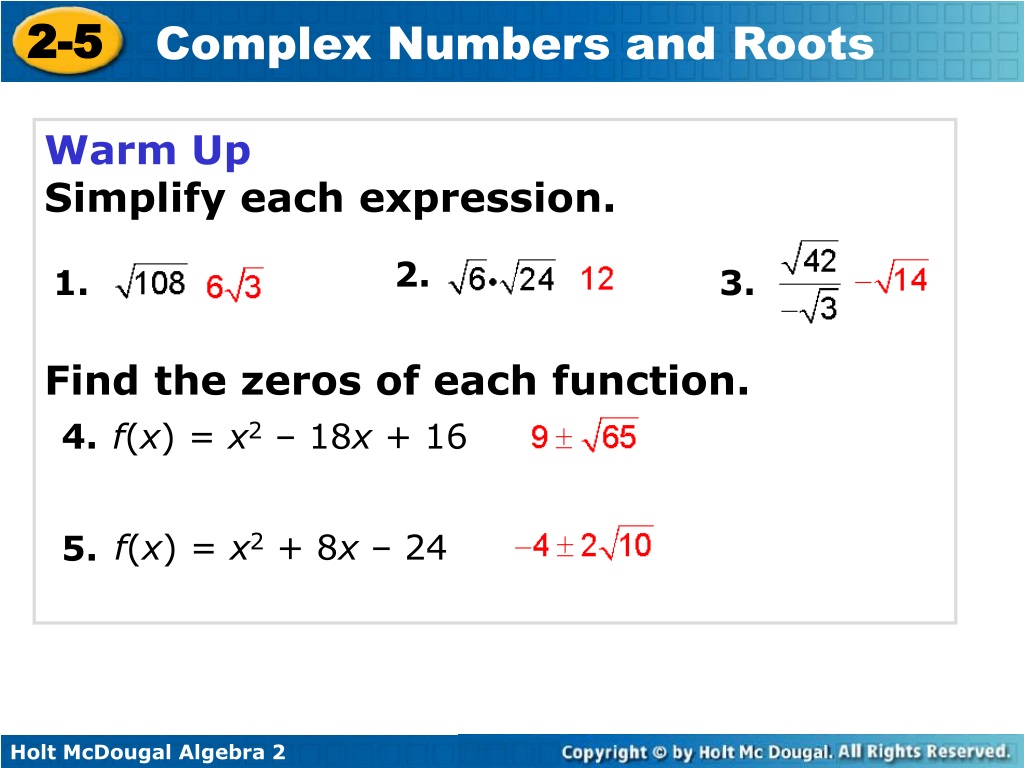
Warm Up Simplify each expression. 2. 1. 3. Find the zeros of each function. 4. f ( x ) = x 2 – 18 x + 16. f ( x ) = x 2 + 8 x – 24. 5. Objectives. Define and use imaginary and complex numbers. Solve quadratic equations with complex roots. Vocabulary. imaginary unit
Warm Up Simplify each expression. - slide 1
01 / 24Warm Up Simplify each expression.
1 / 17

Télécharger la présentation

Warm Up Simplify each expression.
Une image / un lien ci-dessous est fourni (tel quel) pour télécharger la présentation

Politique de téléchargement : le contenu du site vous est fourni TEL QUEL pour votre information et votre usage personnel ; il ne peut être vendu, concédé sous licence ni partagé sur d’autres sites sans l’accord de son auteur.Le contenu vous est fourni TEL QUEL, pour votre information et votre usage personnel uniquement. Téléchargez la présentation en cliquant sur ce lien. Lors du téléchargement, si vous ne parvenez pas à télécharger une présentation, l’éditeur a peut-être supprimé le fichier de son serveur.Pendant le téléchargement, si vous ne parvenez pas à obtenir une présentation, le fichier a peut-être été supprimé par l’éditeur.

F I N

Plus de contenu associé

Transcription de la présentation
  1. Warm Up Simplify each expression. 2. 1. 3. Find the zeros of each function. 4. f(x) = x2– 18x + 16 f(x) = x2+ 8x – 24 5.

  2. Objectives Define and use imaginary and complex numbers. Solve quadratic equations with complex roots.

  3. Vocabulary imaginary unit imaginary number complex number real part imaginary part complex conjugate

  4. However, you can find solutions if you define the square root of negative numbers, which is why imaginary numbers were invented. The imaginary uniti is defined as . You can use the imaginary unit to write the square root of any negative number. You can see in the graph of f(x) = x2 + 1 below that f has no real zeros. If you solve the corresponding equation 0 = x2 + 1, you find that x = ,which has no real solutions.

  5. Example 1A: Simplifying Square Roots of Negative Numbers Express the number in terms of i. Factor out –1. Product Property. Simplify. Multiply. Express in terms of i.

  6. Example 1B: Simplifying Square Roots of Negative Numbers Express the number in terms of i. Factor out –1. Product Property. Simplify. Express in terms of i.

  7. Huddle Express the number in terms of i. Factor out –1. Product Property. Product Property. Simplify. Express in terms of i.

  8. Huddle Express the number in terms of i. Factor out –1. Product Property. Simplify. Multiply. Express in terms of i.

  9. Mastery Express the number in terms of i. Factor out –1. Product Property. Simplify. Multiply. Express in terms of i.

  10. x2 = –144 x2 = –144 (–12i)2 (12i)2 –144 –144 144i 2 –144 144i 2 –144   –144 144(–1) –144 144(–1) Example 2A: Solving a Quadratic Equation with Imaginary Solutions Solve the equation. Take square roots. Express in terms of i. Check

  11. 5x2 + 90 = 0 0 5(18)i 2 +90 0 90(–1) +90 0  Example 2B: Solving a Quadratic Equation with Imaginary Solutions Solve the equation. 5x2 + 90 = 0 Add –90 to both sides. Divide both sides by 5. Take square roots. Express in terms of i. Check

  12. x2 = –36 x2 = –36 (6i)2 (–6i)2 –36 –36 36i 2 –36 36i 2 –36   –36 –36 36(–1) 36(–1) Huddle Solve the equation. x2 = –36 Take square roots. Express in terms of i. Check

  13. + 48 Huddle Solve the equation. x2 + 48 = 0 x2 = –48 Add –48 to both sides. Take square roots. Express in terms of i. Check x2 + 48 = 0 0 (48)i 2+ 48 0 48(–1)+ 48 0 

  14. Mastery Solve the equation. 9x2 + 25 = 0 9x2 = –25 Add –25 to both sides. Divide both sides by 9. Take square roots. Express in terms of i.

  15. A complex number is a number that can be written in the form a + bi, where a and b are real numbers and i = . The set of real numbers is a subset of the set of complex numbers C. Every complex number has a real parta and an imaginary partb.

  16. x2 + 10x + = –26 + Add to both sides. Example 4A: Finding Complex Zeros of Quadratic Functions Find the zeros of the function. f(x) = x2 + 10x + 26 Set equal to 0. x2 + 10x + 26 = 0 Rewrite. x2 + 10x + 25 = –26 + 25 (x + 5)2 = –1 Factor. Take square roots. Simplify.

  17. x2 + 4x + = –12 + Add to both sides. Example 4B: Finding Complex Zeros of Quadratic Functions Find the zeros of the function. g(x) = x2 + 4x + 12 x2 + 4x + 12 = 0 Set equal to 0. Rewrite. x2 + 4x + 4 = –12 + 4 (x + 2)2 = –8 Factor. Take square roots. Simplify.

  18. x2 + 4x + = –13 + Add to both sides. Huddle Find the zeros of the function. f(x) = x2 + 4x + 13 x2 + 4x + 13 = 0 Set equal to 0. Rewrite. x2 + 4x + 4 = –13 + 4 (x + 2)2 = –9 Factor. Take square roots. x = –2 ± 3i Simplify.

  19. x2 – 8x + = –18 + Add to both sides. Mastery Find the zeros of the function. g(x) = x2 – 8x + 18 x2 – 8x + 18 = 0 Set equal to 0. Rewrite. x2 – 8x + 16 = –18 + 16 Factor. Take square roots. Simplify.

  20. The solutions and are related. These solutions are a complex conjugate pair. Their real parts are equal and their imaginary parts are opposites. The complex conjugate of any complex number a + bi is the complex number a – bi. Helpful Hint When given one complex root, you can always find the other by finding its conjugate. If a quadratic equation with real coefficients has nonreal roots, those roots are complex conjugates.

  21. Example 5: Finding Complex Zeros of Quadratic Functions Find each complex conjugate. B. 6i A. 8 + 5i 0 + 6i Write as a + bi. 8 + 5i Write as a + bi. 0 – 6i Find a – bi. 8 – 5i Find a – bi. –6i Simplify.

  22. B. Huddle Find each complex conjugate. A. 9 – i 9 + (–i) Write as a + bi. Write as a + bi. 9 – (–i) Find a – bi. Find a – bi. 9 + i Simplify. C. –8i 0 + (–8)i Write as a + bi. 0 – (–8)i Find a – bi. 8i Simplify.

  23. 1. Express in terms of i. Lesson Quiz Solve each equation. 3.x2 + 8x +20 = 0 2. 3x2 + 96 = 0 4. Find the values of x and y that make the equation 3x +8i = 12 – (12y)i true. 5. Find the complex conjugate of