Download
1 / 1
10 likes | 127 Vues
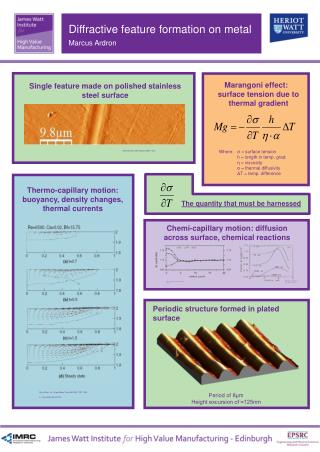
This study explores the creation of diffractive features on polished stainless steel surfaces using the Marangoni effect, which arises from thermal gradients impacting surface tension. The research analyzes the thermo-capillary and chemi-capillary motions responsible for the formation of periodic structures. Key parameters include surface tension, viscosity, and temperature differences, which are manipulated to achieve desired optical effects on the metal. Findings are substantiated by various academic references highlighting the implications for material science and surface engineering.

E N D
Suggested palette of box colours – for use if required and to be sized as required Diffractive feature formation on metal Marcus Ardron • Marangoni effect: surface tension due to thermal gradient Where: σ = surface tension h = length in temp. grad. η = viscosity α = thermal diffusivity ΔT = temp. difference Single feature made on polished stainless steel surface Thermo-capillary motion: buoyancy, density changes, thermal currents The quantity that must be harnessed Chemi-capillary motion: diffusion across surface, chemical reactions 304 stainless steel processed in CO2 Periodic structure formed in plated surface Balandin et al. J Appl Phys 78(3) 1995 2037-2044 Nink et al. Appl Surf Sci 138-139 (1999) 439-443 Period of 8μm Height excursion of ≈125nm Sim & Kim. Int J Heat Mass Tran 48(2005) 1137-1144 t = non-dimensional time