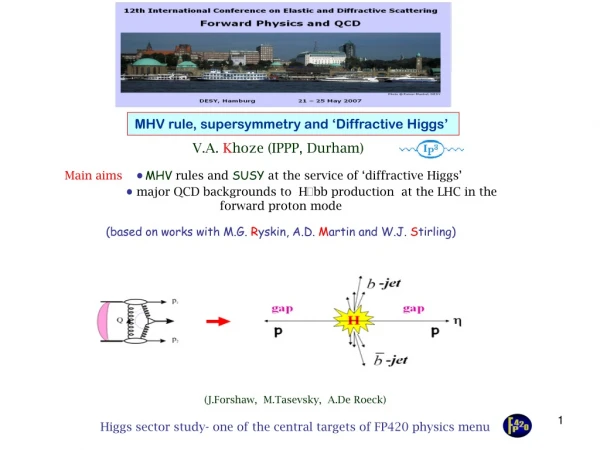
Higgs Diffractive Production
This work explores the diffractive production of the Higgs boson, highlighting the low production probabilities and significant background challenges. We discuss strategies to enhance detection, focusing on the central production region and heavy quark contributions at high-energy collisions such as those at the LHC. The paper emphasizes the role of quantum fluctuations and the intricate wave functions involved, offering insights into non-perturbative and perturbative effects. We summarize conclusions on potential Higgs production mechanisms and avenues for experimental investigation.

Higgs Diffractive Production
E N D
Presentation Transcript
Higgs Diffractive Production Ivan Schmidt Trieste 2006
Unknown mass • Small production probability and large backgrounds • Coupling ~ mass hard to observe in pp But : 1) Small (1% probability for c) ~ 2) Reduce backgrounds from multiparticle production Diffractive production in fragmentation region of one of the protons Higgs detection
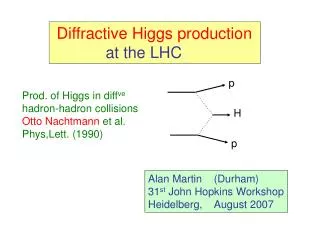
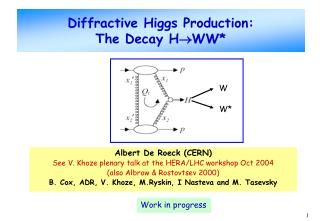
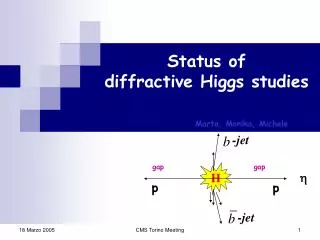
Concrete possibilities : 1) Central region (MKKRS) 2) Heavy quarks in proton large p S. Brodsky H B. Kopeliovich J. Soffer I. S. p p p H p • Large rapidity gap • Missing mass measurement
1) Non-perturbative (stationary state) 300 MeV 2) Perturbative (quantum fluctuation) Experimentally: DIS data, excess at large Large production
Form factors (gluon coupling to all quarks) Vanish as (suppression) Born Exclusive diffraction calculation
1) Factorized form for proton wf 2) Calculate at t=0 , and assume Pomeron-type t-dependence 3) Replace two-gluon proton vertex by gluon density Includes higher order corrections fitted to data Only odd powers of change of orbital angular momentum • initial in S-wave • final in P-wave H is scalar ( different for : P-wave initial state) Calculational steps
( for and ) ( for ) 5) wavefunction ( FT of energy denominator ) 6) Relative motion of and qqq clusters a) Non-perturbative heavy flavors b) Perturbative heavy flavors 4) Higgs wavefunction (P-wave)
Non-perturbative Perturbative Perturbative Final result • For LHC energy (14 TeV cm) • Perturbative heavy flavors • Includes absorptive corrections ( 20% at LHC) • IT falls for GeV • Heavy quark probability ~
1) From colorless heavy pair Does not have proton form factor But Amplitude suppressed 2) Nuclear enhancement Not as big as one might think Stronger absorptive corrections Factor of ~ 10 for Pb Larger cross section
Heavy quark components carry high momentum fractions. • Higgs production in fragmentation region. • Diffractive production • Also possible: , . • Difficult detection . Conclusions