Download
1 / 9
90 likes | 208 Vues
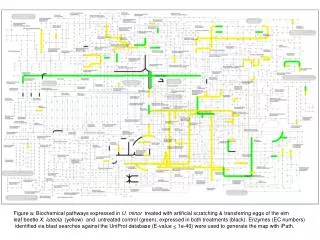
This study investigates biochemical pathways in U. minor subjected to various treatments, including artificial scratching, egg transfer, oviposition, and feeding by the elm leaf beetle X. luteola. Comparative analysis with untreated control samples reveals significant metabolic responses. Enzymes were identified through BLAST searches against the UniProt database (E-value < 1e-40), allowing for the generation of detailed metabolic maps using iPath. Pathways were categorized based on treatment conditions, showcasing the plant's adaptive mechanisms in response to herbivory and artificial stress.

E N D
Figure a: Biochemical pathwaysexpressed in U. minor treated with artificial scratching & transferring eggs of the elm • leaf beetle X. luteola(yellow) and untreated control (green), expressed in both treatments (black). Enzymes (EC numbers) identified via blast searches against the UniProtdatabase (E-value < 1e-40) were used to generate the map with iPath.
Figure b: Biochemical pathwaysexpressed in U. minor treated withoviposition and feeding of the elm leaf beetle X. luteola (blue) and untreated control (green), expressed in both treatments (black). Enzymes (EC numbers) identified via blast searches against the UniProtdatabase (E-value < 1e-40) were used to generate the map with iPath.
EF= blau, E=gelb, schwarzbeide • Figure c: Biochemical pathwaysexpressed in U. minor treated withoviposition and feeding of the elm leaf beetle X. luteola • (blue) and treated with artificial scratching & transferring eggs (yellow), expressed in both treatments (black). Enzymes (EC numbers) identified via blast searches against the UniProtdatabase (E-value < 1e-40) were used to generate the map with iPath.
Figure d: Biochemical pathwaysexpressed in U. minor treated withoviposition and feeding of the elm leaf beetle X. luteola • (blue) and treated with treatment with methyl jamonate (cyan), expressed in both treatments (black). Enzymes (EC numbers) identified via blast searches against the UniProtdatabase (E-value < 1e-40) were used to generate the map with iPath.
Figure e Biochemical pathwaysexpressed in U. minor treated withoviposition and feeding of the elm leaf beetle X. luteola • (blue) and treated only with feeding (red), expressed in both treatments (black). Enzymes (EC numbers) identified via blast searches against the UniProtdatabase (E-value < 1e-40) were used to generate the map with iPath.
Figure f: Biochemical pathwaysexpressed in U. minor treated with feeding of the elm leaf beetle X. luteola • (red) and treated with with methyl jamonate (cyan), expressed in both treatments (black). Enzymes (EC numbers) identified via blast searches against the UniProtdatabase (E-value < 1e-40) were used to generate the map with iPath.
Figure g: Biochemical pathwaysexpressed in U. minor treated withfeeding of the elm leaf beetle X. luteola (red) and untreated control (green), expressed in both treatments (black). Enzymes (EC numbers) identified via blast searches against the UniProtdatabase (E-value < 1e-40) were used to generate the map with iPath.
Figure h Biochemical pathwaysexpressed in U. minor treated with feeding of the elm leaf beetle X. luteola (blue) and untreated control , expressed in both treatments (black). Enzymes (EC numbers) identified via blast searches against the UniProtdatabase (E-value < 1e-40) were used to generate the map with iPath.
Figure i: Biochemical pathwaysexpressed in U. minor treated with oviposition and feeding of the elm leaf beetle X. luteola (blue) and untreated control, expressed in both treatments (black). Enzymes (EC numbers) identified via blast searches against the UniProtdatabase (E-value < 1e-40) were used to generate the map with iPath.