Efficient Data Representation with Wavelets: A Journey through Inner Product Spaces and FFT
Explore the foundational concepts of wavelets as powerful tools for efficiently decorrelating data. This overview delves into the transformation of signals into compact representations, leveraging inner product spaces and the Discrete Fourier Transform (DFT). Understand how geometric relationships in data can be captured, and learn about the Fast Fourier Transform (FFT) technique that enhances computation without sacrificing speed. Discover the interplay between modular addition and roots of unity, and witness the crucial role of orthonormal bases in signal analysis.

Efficient Data Representation with Wavelets: A Journey through Inner Product Spaces and FFT
E N D
Presentation Transcript
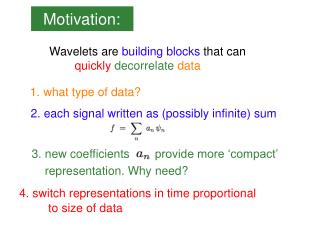
Motivation: Wavelets are building blocks that can quickly decorrelatedata 1. what type of data? 2. each signal written as (possibly infinite) sum 3. new coefficients provide more ‘compact’ representation. Why need? 4. switch representations in time proportional to size of data
Inner product spaces and the DFT real: Familiar 3-space complex: Basis: Energy: real: complex:
Geometry via inner products dot product, inner product real: complex: capture basic geometry of 3-space correlation: parallel perpendicular
Inner product space . capturelinearcombinationsandgeometry vector space (over reals or complex numbers) such that for all in , in . defn Energy:
Basic Example: . Inner product: Energy: Standard basis: Standard representation:
Basic Example: . Addition structure on : defn modular addition. Set , Roots of unity: Multiplication structure on :
Basic Example: . Notation: denotes all functions With inner product becomes inner product space: Fundamental Theorem: (Standard Basis) is orthonormal basis for .
. and DFT Important idea for DFT: each in defines function such that . Fundamental Theorem: (Fourier Basis) is orthonormal basis for . DFT: Standard basis Fourier basis
DFT . use signal analysis notation function: Fourier representation: Fourier Transform: where measures correlation of with each
DFT as Matrix But there are multiplications here. What happened to the idea of doing things quickly? Fast Fourier Transform: FFT
Fourier Matrix N = 2:
Examples: N = 4 = 2x2: still 16 multiplications, but it looks promising!
Examples: N=8=2x2x2: Now 2 x 3 x 8 multiplications. Seeanypatterns?