The Renaissance: A Cultural Rebirth from 14th to 17th Century Italy
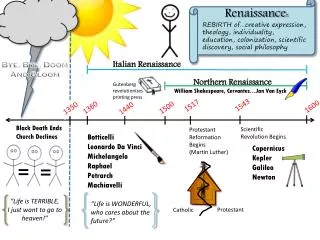
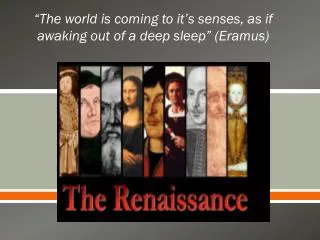
The Renaissance, meaning "rebirth," spanned from the 14th to the 17th century, primarily starting in Italy during the mid-1300s and flourishing throughout Europe by the 1500s. This period marked a renewed interest in the culture of Ancient Rome, spurred by Italy's thriving city-states like Florence, Milan, and Venice, which outlasted the Black Death. Wealthy patrons like the Medici family played a crucial role in supporting the arts, leading to remarkable advancements by artists such as Leonardo da Vinci and Michelangelo, and thinkers like Galileo and Machiavelli.

The Renaissance: A Cultural Rebirth from 14th to 17th Century Italy
E N D
Presentation Transcript
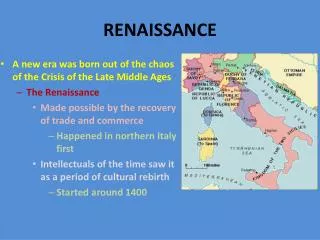
The Renaissance • “Rebirth” • 14th – 17th century (1300s – 1600s) • Began in Italy in the mid-1300s; spread throughout Europe • Reached its height in the 1500s
Why Italy? • Reawakened interest in the culture of Ancient Rome • Italian city-states survived the Black Death (Florence, Milan, Venice, Genoa, Rome, and Naples) • Wealthy, powerful bankers and merchants • Florence gifted poets, artists, scholars, and scientists • The Medici Family • became the richest bankers and merchants in Europe • gained control of Florentine government in 1434 • money translated into cultural and political power
Lorenzo de Medici • clever politician • held Florence together during difficult times • generous patron (financial supporter) of the arts • Poets, artists and philosophers frequently visited the Medici palace