Understanding Solutions: Types, Concentration, and Properties
This guide explores key concepts of solutions, including homogeneous mixtures, solute, and solvent definitions, and molarity calculations. Learn to determine molarity of solutions using examples like dissolving NaOH and HCl, comprehend the behavior of electrolytes, and understand solubility principles. It covers saturation states (saturated, unsaturated, supersaturated), concentrated vs. dilute solutions, and factors affecting dissolution such as surface area, stirring, and temperature. Solve dilution problems with the formula M1V1=M2V2 for real-world applications.

Understanding Solutions: Types, Concentration, and Properties
E N D
Presentation Transcript
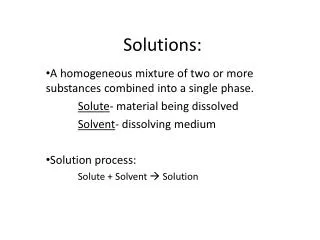
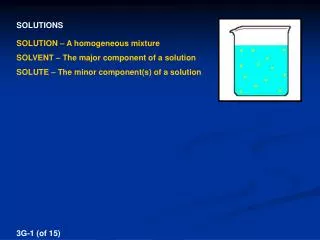
SOLUTIONS A homogeneous mixture in which the components are uniformly intermingled
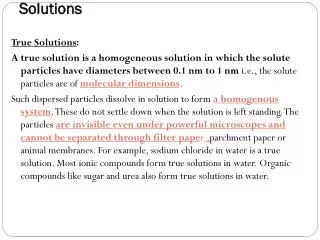
Terms Solvent – The substance present in the largest amount in a solution. The substance that does the dissolving. Solute – The other substance or substances in a solution. The substance that is dissolved.
MOLARITY • Molarity-the number of moles of solute per liters of solution • M = molarity = moles of solute liter of solution
Calculate the molarity of a solution prepared by dissolving 11.5 g of NaOH in enough water to make a 1.50 L solution.
Calculate the molarity of a solution prepared by dissolving 1.56 g of HCl into enough water to make 26.8 ml of solution.
Calculate the number of grams of sodium phosphate required to make 150. ml of a 2.5M solution.
How many liters of solution are needed to dissolve 5.0 g of hydrochloric acid to make a 3.0 M hydrochloric acid solution?
ELECTROLYTES • Substances that break up in water to produce ions. • These ions can conduct electric current • Examples: Acids, Bases and Salts (ionic compounds)
SOLUBILITY • “Like dissolves Like” • Polar molecules dissolve polar molecules • Nonpolar molecules dissolve nonpolar molecules
SOLUBILITY RULES • All common salts of Group I elements and ammonium are soluble • All common acetates and nitrates are soluble • All binary compounds of Group 7 with metals are soluble except those of silver, mercury I and lead • All sulfates are soluble except those of barium, strontium, calcium, silver, mercury I and lead • Except for those in Rule 1, carbonates, hydroxides, oxides, sulfides and phosphates are insoluble
Terms • Saturated • When a solution contains the maximum amount of solute • Unsaturated • When a solvent can dissolve more solute • Supersaturated • When the solution contains more solute than a saturated solution will hold at that temperature • Concentrated • When a relatively large amount of solute is dissolved • Dilute • When a relatively small amount of solute is dissolved
Factors Affecting the Rate of Dissolution • Surface Area • Stirring • Temperature
DILUTIONS • M1 x V1 = M2 x V2 • What volume of 16 M sulfuric acid must be used to prepare 1.5 L of a 0.10 M H2SO4 • What volume of 12 M HCl must be used to prepare 0.75 L of a 0.25 M HCl?