Download

1 / 11
110 likes | 269 Vues
This summary delves into the key factors that led to the 1929 economic crash and the subsequent Great Depression, highlighting poor wealth distribution, reliance on credit, declining consumer spending, and speculative stock market practices. It examines how farm failures and bank closures exacerbated the crisis, leading to widespread unemployment and the rise of Hoovervilles populated by homeless wanderers, known as hobos. Additionally, it mentions the Dust Bowl's devastating impact on agriculture and culture, with notable writers and musicians capturing the era's struggles.

E N D
Americans Face Hard Times 11-2 and 11-3 Notes
Causes of the 1929 Crash Economic Factors Financial Factors • Poor distribution of wealth • Consumers relied on credit • Consumer spending dropped • Industry struggled • Stock markets rise in 1920s • Speculation in stock increases • Margin buying • Stock prices rise to unrealistic levels
Key Terms: • Hobos – jobless, homeless wanderers • Great Depression – most severe economic downturn in the history of the U.S. • Foreclosure – when a bank or other lender takes over ownership of a property from an owner who has failed to make loan payments.
Key Terms Continued • Hoovervilles – sprawling neighborhoods of shacks sprang up on the outskirts of towns and public parks. – blamed this on president Hoover
Key Terms Continued: • Drought – a period of below-average rainfall, this lasted several years during the 1930s • Dust Bowl – Oklahoma, Kansas, Colorado, New Mexico, and Texas became known as this due to large wind storms and dry dusty conditions
Bank Failures • Many had entrusted their savings to banks. • How has that changed today? • Insurance from the federal government protects most people’s deposits • Laws require that a bank keep a greater percentage of assets in cash to be paid out by depositors • 1930 – almost 350 banks closed due to runs.
Farm Failures • Faced hard times in 1920s – got worse in the 30s • Farmers produced more than they could sell and price dropped drastically • How does this effect farmers income? • Many suffered foreclosure
Unemployment • 1933 – GNP dropped 40% • Unemployment reached a high of 25% (50% in some areas such as Harlem)
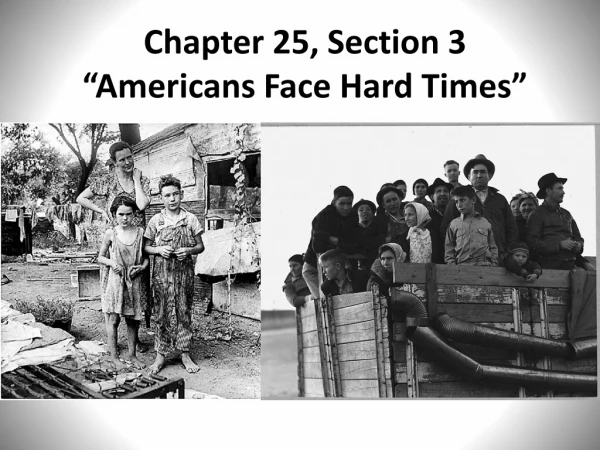
Hoovervilles and Hobos • 1930s no federal government provided food or money to the poor • Hoovervilles are established as a result • Hobos often jumped trains traveling from town to town looking for work or a place to live. • Hobos had dangerous lifestyle – develop sign language to determine if a town was a safe place for them
Dust Bowl • Caused many deaths due to inhalation of dust. • Destroyed crops and buried farm equipment
Writers and Musicians • Woody Guthrie – songs about the dust bowl describe the disaster’s effect on the people • John Steinbeck – wrote several books describing life during the depression and dust bowl – often very tragic endings