Download
1 / 6
60 likes | 193 Vues
Metal is composed of closely packed cations, enabling free movement of valence electrons which results in low ionization energy, causing metals to easily lose electrons. This leads to unique metallic bonding, characterized by free-floating valence electrons attracted to positively charged metal ions. These free electrons are responsible for essential metallic properties such as high electrical conductivity, malleability, ductility, and luster. Additionally, alloys—mixtures of metals with other elements—exhibit superior properties, with examples including steel, bronze, and sterling silver.

E N D
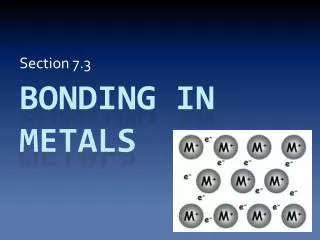
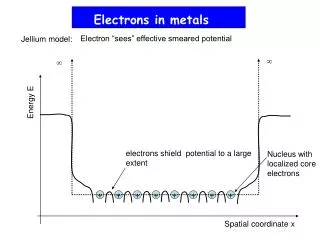
Metals • Made up of closely packed cations • Not neutral atoms • Valence e- can move Recall: What type of ionization energy do metals have? Low = tend to lose e-
Metallic Bonding • Free floating valence e- are attracted to (+) metal ions
Free floating valence e- explain metallic properties: • Good conductors • Malleable & Ductile • Luster
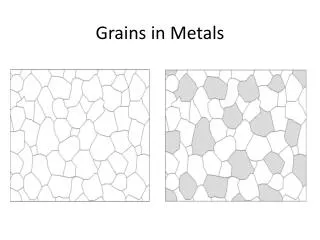
Crystalline Structure • Metal atoms are arranged in very compact & orderly patterns
Alloys • Mixtures that contain a metal & one or more ‘other’ elements • Superior properties • Examples: Sterling Silver – Bronze – Steel – Titanium - Silver & Copper Copper & Tin Iron, Carbon, Chromium, Nickel Aluminum & Vanadium