Chapter 13: Genetic Engineering
This chapter explores the concepts of selective breeding and genetic engineering, emphasizing how desired traits can be achieved without directly manipulating DNA. Selective breeding involves choosing organisms with preferred characteristics to produce the next generation, such as racing horses or crops like hybrid corn and potatoes. It also delves into genetic engineering techniques, including DNA extraction, the role of restriction enzymes, and the creation of recombinant DNA. The chapter highlights practical applications in agriculture and medicine, such as improving crop yields and producing human insulin.


Chapter 13: Genetic Engineering
E N D
Presentation Transcript
How could you get a desired trait without directly manipulating the organisms’ DNA? • Selective Breeding - choosing organisms withdesired traits to produce the next generation • Breeding the winners of a horse race • Selecting a person with a certain eye color or features • Taking the seeds from the Great Pumpkin
Hybridization • Crossing organisms of different traits to produce a hardier product Ex. A mule is a cross of a horse and a donkey – Sturdy and surefooted Hybrid corn – tastes good and is more resistant to disease. Hybrid potatoes (Burbank)- disease resistant, exported to Ireland to fight blight disease
Inbreeding • Maintaining the present genes bybreeding only within the population • Ex. Pedigree animals • Risk that recessive traits show up that may be lethal or harmful. • Problems with certain breeds, for example hip problems in German shepards
Increasing variations by Inducing mutations By using known mutagens, attempt to force mutations to occur • Radiation & Chemicals • Not a sure bet nor do you know what you are going to get • Polyploidy (3N or 4N) plants have resulted from this – larger & hardier • Bacteria that can digest oil, too
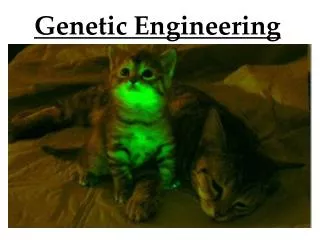
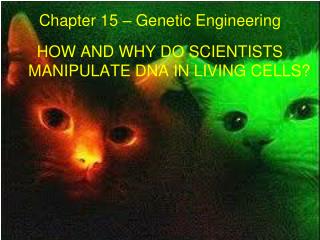
Glofish: the first genetically modified animal to be sold as a pet Researchers in Singapore added a fluorescence gene from a sea coral to zebra danio eggs to produce glofish.
Now let’s manipulate the genes by altering the organism’s DNA • Genetic Engineering – science involved in the ability to manipulate genes/DNA • Purpose: • Cure disease (Cystic Fibrosis) • Treat genetic disorders (Hemophilia, diabetes) • Improve food crops (better tasting, longer shelf life, fungus resistance…) • Improve human life in general
The Tools: • DNA Extraction – Chemical procedure (we’ll do this) • Restriction enzymes– molecular scissors that cut DNA at specific nucleotide sequences • Gel Electrophoresis– method to analyze fragments of DNA cut by restriction enzymes through a gel made of agarose (molecular sieve) • DNA Ligase – molecular glue that puts pieces of DNA together • Polymerase Chain Reaction (PCR)- molecular copy machine. Makes millions of copies of DNA/hr
Let’s suppose that you are a diabetic and can not make your own insulin. What are you to do? • Inject insulin of course but from what source? • Old method was to use sheep insulin. Costly and labor intensive • New method: Let bacteria with a human insulin producing gene make it for you
The Method: • Transformation of a bacterium to produce human insulin 1. Extract the total genomic DNA from a healthy human 2. Using a restriction enzyme, cut the insulin producing gene out of a the DNA
What are restriction enzymes? • Bacterial enzymes – used to cut bacteriophage DNA (viruses that invade bacteria). • Different bacterial strains express different restriction enzymes • Restriction enzymes recognize a specific short nucleotide sequence • For example, Eco RI recognizes the sequence: • 5’ - G A A T T C - 3’ • 3’ - C T T A A G - 5’ • Pandindrones same base pairing forward and backwards
Let’s try some cutting: • Using this piece of DNA, cut it with Eco RI • G/AATTC • GACCGAATTCAGTTAATTCGAATTC • CTGGCTTAAGTCAATTAAGCTTAAG • GACCG/AATTCAGTTAATTCG/AATTC • CTGGCTTAA/GTCAATTAAGCTTAA/G
What results is: • GACCG AATTCAGTTAATTCG AATTC • CTGGCTTAA GTCAATTAAGCTTAA G Sticky end - tails of DNA – easily bind to other DNA strands Sticky end
Blunt & Sticky ends • Sticky ends – Creates an overhang. • Blunts- Enzymes that cut at precisely opposite sites without overhangs. SmaI is an example of an enzyme that generates blunt ends
3. Cut cloning vector: • Use bacterial plasmids • Plasmids will be cut with the same restriction enzyme used to cut the desired gene
4. Ligation - Donor gene (desired gene) is then spliced or annealed into the plasmid using DNA ligase as the glue. Recombinant DNA - DNA with new piece of genetic information on it • 5. Plasmid is then returned to bacterium and reproduces with donor gene in it. Transgenic organism – organism with foreign DNA incorporated in its genome (genes) • 6. Bacterium reproduces and starts producing human insulin gene which we harvest from them.
Recombinant DNA Donor Gene
Practical Use of DNA technology • Pharmaceutical products – insulin, HBCF (human blood clotting factor) • Genetically engineered vaccines –Introduced viral proteins will trigger an immune response and the production of antibodies
3. Increasing agricultural yields – • New strains of plants – GMO – Genetically modifiedorganism • Insect resistant plants – Insert gene that kills larvae when larvae try to eat the plant – Not always specific to harmful species!! – Monarch problem • Disease resistance – Fungal resistance in tomatoes, corn, soybean • Herbicide resistance - *Round Up won’t harm the good plants, only the bad plants (weeds) – cheaper and less labor extensive than weeding • Getting genes from Nitrogen fixing bacteria inserted into plants – fix their own nitrogen (a must for plants) in N poor soils • Salt tolerant plants – can grow plants where high concentrations of salt in the air or soil
Improve quality of produce - Slow down the ripening process – ship when un-ripened, to market when ripe - Enhance color of produce - Reduce hairs or fuzz on produce - Increase flavor - Frost resistance
Parts of the world with Vitamin A deficiency related health issues
Would you believe that once upon a time carrots were white or purple? Orange-coloured carrots are the product of a mutation selected by a Dutch horticulturist a few hundred years ago because it was the colour of the Dutch Royal House of Orange-Nassau!
The negatives • Problem with transgenic foods is that an introduced gene may produce a protein that someone may be sensitive to. • FDA does not require that on a label (here in the US) • If a label starts with a “(8), then it’s a GMO product – 84011 = GMO banana • Also, may create “superweeds” that cross pollinate with others & may take over environment