
SlideServe
Menu
Préférences
© SlideServe · v2026

Total Knee Replacement

morgan-allen avatar
10 diapositives · 531 Views · Nov 14, 2014

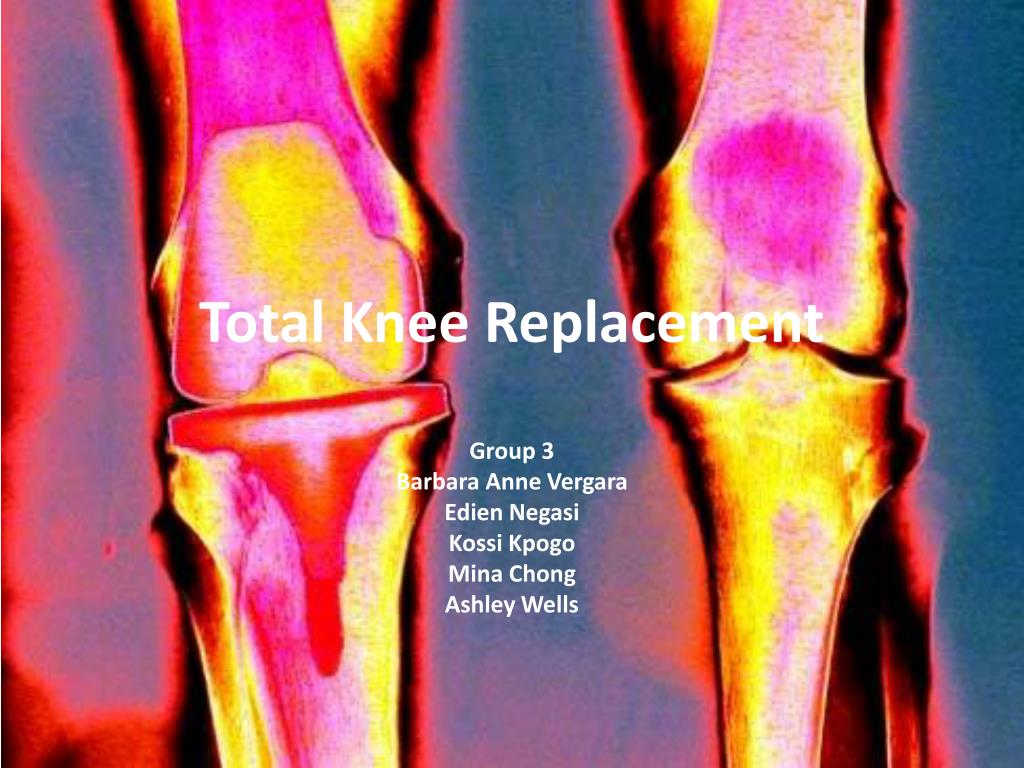
Total Knee Replacement. Group 3 Barbara Anne Vergara Edien Negasi Kossi Kpogo Mina Chong Ashley Wells. Total Knee Replacement. Pathophysiology : CAUSE: Arthritis in the knee
Total Knee Replacement - slide 1
01 / 10Total Knee Replacement
1 / 17

Télécharger la présentation

Total Knee Replacement
Une image / un lien ci-dessous est fourni (tel quel) pour télécharger la présentation

Politique de téléchargement : le contenu du site vous est fourni TEL QUEL pour votre information et votre usage personnel ; il ne peut être vendu, concédé sous licence ni partagé sur d’autres sites sans l’accord de son auteur.Le contenu vous est fourni TEL QUEL, pour votre information et votre usage personnel uniquement. Téléchargez la présentation en cliquant sur ce lien. Lors du téléchargement, si vous ne parvenez pas à télécharger une présentation, l’éditeur a peut-être supprimé le fichier de son serveur.Pendant le téléchargement, si vous ne parvenez pas à obtenir une présentation, le fichier a peut-être été supprimé par l’éditeur.

F I N

Plus de contenu associé

Transcription de la présentation
  1. Total Knee Replacement Group 3 Barbara Anne Vergara EdienNegasi KossiKpogo Mina Chong Ashley Wells

  2. Total Knee Replacement • Pathophysiology: • CAUSE: Arthritis in the knee • “Arthritis” means 'inflammation of the joint.' Wearing away of cartilage in the joint -- is the end result of inflammation within the joint. • Most common type of knee arthritis is osteoarthritis. This is often referred to as "wear-and-tear" arthritis • Results in the wearing away of the normal smooth cartilage until bare bone is exposed. Other types of arthritis include rheumatoid arthritis, gouty arthritis, and lupus arthritis. • Total knee replacement surgery has long been used to treat severe arthritis in elderly patients. • However, concerns arise when a patient in his 40s or 50s has severe knee arthritis that is not relieved with conservative treatments. Once reserved for elderly patients, total knee replacement surgery is becoming more common in the younger, active population.

  3. Key Assessments • Pain – Rate your pain on scale, 0-10 • Paresthesia – Tingling? • Pallor- Capillary refill? Mucous membranes? • Polar – Warm to touch? Clammy? • Paralysis - ROM • Pulses – Palpable? • *LABS: WBC- Infection, drainage?

  4. Objective and Subjective Data Subjective: • “healthy” on no home medications other than NSAID Objective: • 64 Male • S/p RIGHT, Total knee Replacement

  5. NursingDiagnosis • Acute pain r/tTKR, AEB eight inches (20 cm) long incision. • Altered Mobility r/t TKR, AEB use of wheelchair • Risk for Infection r/t incision. • Disturbed Image r/t TKR, AEB, scarring and decreased mobility overall. • Impaired Comfort r/t TKR, AEB grimacing.

  6. Outcome/Goal and Outcome Criteria • Client will rate pain on pain scale. Will take and follow strict medication regimen. • Client will do ROM exercises every am for 10 minutes. • Client will inspect hip incision every day for redness, heat, or drainage • Client will demonstrate hip insicion care with mild soap and water and be sure to dry it thoroughly. • Client will be placed on high protein and vitamin C diet • Client will cough and deep breathe.

  7. Intervention • Assess VS and pain every hour. • Assess client’s needs holistically. • Will assist patient into wheelchair on the day of surgery. • Will teach patient to walk up and down the stairs as needed. • Assess pain, paresthesia, pulse, polar, pallor, and paralysis. • Assess R.O.M. • Assess infection

  8. Rationale • To promote healing. • Systematic ongoing assessment and documentation provide direction for treatment plan: adjustments are based on clients response, (Barry 2006.) • Prevent Infection

  9. Evaluation • Client will not experience complications such as weak peripheral pulses, tachycardia, and angina. • Client will verbalize importance signs and symptoms to report. • Client will accurately describe recommended dietary restrictions and medication regimens.

  10. Sources: • http://orthoinfo.aaos.org/menus/arthroplasty.cfm • Nursing Diagnosis Handbook, Ackley, B.