Understanding Nomenclature of Binary and Ternary Compounds
This guide delves into the nomenclature of binary and ternary compounds, including specific naming rules for compounds formed by metals with fixed and variable oxidation states, as well as nonmetals. It explains how to apply the Criss-Cross Rule for naming and provides examples such as sodium chloride and aluminum iodide. Additionally, it covers the naming of common cations and anions, giving clarity to the terminology utilized in chemical formulas. Essential for students and chemistry enthusiasts, this resource compiles critical concepts into a comprehensive overview.

Understanding Nomenclature of Binary and Ternary Compounds
E N D
Presentation Transcript
Binary Compounds - Metal (fixed oxidation) + Nonmetal Criss-Cross Rule Binary Compounds - Metal (variable oxidation) + Nonmetal Binary Compounds - Nonmetal + Nonmetal Ternary Compounds Binary Hydrogen Compounds Meaning of Suffixes Empirical Formulas Subscripts, Superscripts, and Coefficients Centrum Multivitamin Polyatomic Ions Table of Contents‘Nomenclature’
Four Types of Naming • Binary compounds • Ternary compounds • Coordination compounds • Organic compounds Contain only two types of elements Contain more than two types of elements These will not be covered We will cover these in a separate unit
Binary Compounds Metals (fixed oxidation) + Nonmetals
Binary Compounds Binary compounds that contain a metal of fixed oxidation number (group 1, group 2, Al, Zn, Ag, etc.), and a non-metal. To name these compounds, give the name of metal followed by the name of the non-metal, with the ending replaced by the suffix –ide. Examples: NaCl sodium chloride (Na1+ Cl1-) CaS calcium sulfide (Ca2+ S2-) AlI3 aluminum iodide (Al3+ I1-)
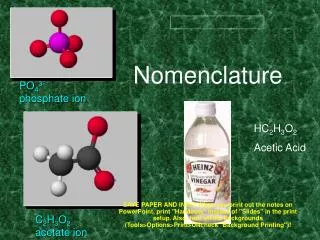
Cations and Anions Common Simple Cations and Anions Cation Name Anion Name* H 1+ hydrogen H 1-hydride Li 1+ lithium F 1-fluoride Na 1+ sodium Cl 1-chloride K 1+ potassium Br 1-bromide Cs 1+ cesium I 1-iodide Be 2+ beryllium O 2-oxide Mg 2+ magnesium S 2-sulfide Al 3+ aluminum Ag 1+ silver *The root is given in color. Zumdahl, Zumdahl, DeCoste, World of Chemistry2002, page 86
Ionic Binary Compounds:Single-Charge Cations Ionic Binary Compounds: Single-Charge Cations Ionic Binary Compounds: Single-Charge Cations Keys