Progress Update on SiD Silicon-Tungsten Electromagnetic Calorimeter Developments
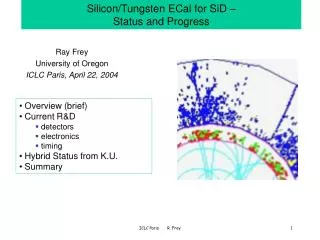
This document provides an update on the baseline configuration and ongoing R&D for the SiD silicon-tungsten electromagnetic calorimeter (ECal). Key features include transverse segmentation of 12 mm² pixels, longitudinal structures, and an EM resolution of 17%/sqrt(E). The KPiX readout chip and mechanical design efforts are highlighted, alongside incremental progress in prototype evaluations and testing methodologies. We discuss options for enhancing particle flow analysis and are exploring various clustering algorithms and EM shower identification techniques.

Progress Update on SiD Silicon-Tungsten Electromagnetic Calorimeter Developments
E N D
Presentation Transcript
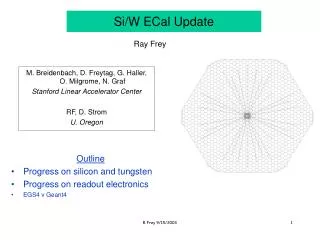
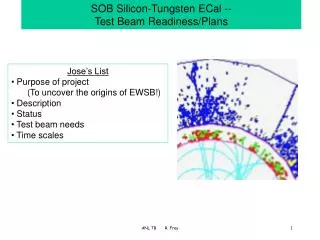
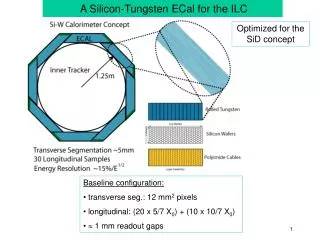
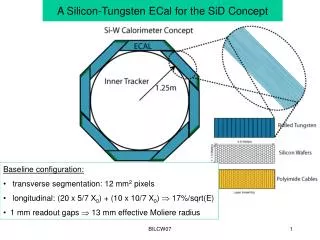
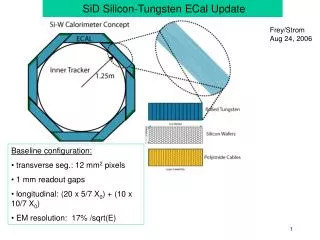
SiD Silicon-Tungsten ECal Update Frey/Strom Aug 24, 2006 • Baseline configuration: • transverse seg.: 12 mm2 pixels • 1 mm readout gaps • longitudinal: (20 x 5/7 X0) + (10 x 10/7 X0) • EM resolution: 17% /sqrt(E)
Si/W ECal R&D Collaboration • KPiX readout chip • downstream readout • detector, cable development • mechanical design and integration • detector development • readout electronics • readout electronics • cable development • bump bonding • mechanical design and integration M. Breidenbach, D. Freytag, N. Graf, R. Herbst, G. Haller, J. Jaros, T. Nelson Stanford Linear Accelerator Center J. Brau, R. Frey, D. Strom, M. Robinson, A. Tubman U. Oregon V. Radeka Brookhaven National Lab B. Holbrook, R. Lander, M. Tripathi UC Davis S. Adloff, F. Cadoux, J. Jacquemier, Y.Karyotakis LAPP Annecy
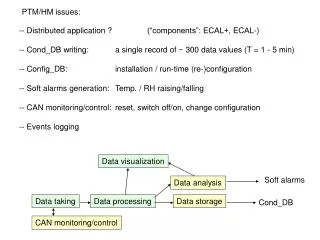
Status/News • KPiX readout chip (64 chan prototypes) • v2 prototype functions (with quirks) • Under evaluation at SLAC and Oregon • v3 submitted 7/ 27/ 06 • Trigger (for tests) • Inverter (for GEMs) • v1024 early 2007 ? • Incremental progress on prototype Si detectors in lab • Ready to submit v2 • Is compatible with KPiX-1024 • Flex readout cable v1 design ready • Tech prototype(s): KPiX-v2/3 + Si-v1 + flex-v1 Bump bonding (Davis) • Full-depth module: KPiX-v1024 + Si-v2 + flex-v? • LCDRD supplementary proposal subm 7/06 • for Si-v2 detectors, bump bonding, flex cables • Oregon and Davis: 2x150k$
ECal R&D Plan (Outline) status
Some needed studies... • Longitudinal structure (baseline is a motivated guess) • What EM resolution is required ? • Particle flow (photon E res. shouldn’t contribute) • id of tau final states • o reconstruction (eg G. Wilson)? High energy? • Depth (containment) and numbers of layers (money, E resolution, pattern recognition of EM) • Don’t yet know how well HCal can help with EM resolution (!) • Segmentation • gamma-gamma and h –gamma separability • Can use fast MC to evaluate effects (leftover project from last summer) • Clustering algorithms • EM shower id !!! • Not yet using the high-quality, well-defined 3-d shower profiles • Raison d’etre studies • jet/pflow processes • Without beam constraint (eg invisible decays) • Jet combinatorics in complicated finals states • Tau id and final-state reconstruction (pol) • Photon tracking; heavy quark id (eg electrons in jets, neutrino recon)