Bee Health Project
350 likes | 481 Vues
The OIE establishes standards for the prevention and control of honey bee diseases as part of its mandate to safeguard animal health and ensure safe animal product trade. Key elements include chapters on official health control of bee diseases, model veterinary certificates, and specific guidelines for managing the six notable honey bee diseases, such as Varroosis and American foulbrood. These standards aim to support veterinary authorities in implementing effective disease surveillance, breeding, and health certification, ultimately enhancing bee health and apiculture productivity.


Bee Health Project
E N D
Presentation Transcript
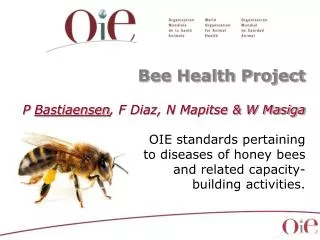
Bee Health Project P Bastiaensen, F Diaz, N Mapitse & W MasigaOIE standards pertaining to diseases of honey bees and related capacity-building activities.
OIE develops standards in relation to its mandates : • for the prevention and control of animal diseases as well as for the safe trade of animals and animals products (mandated under the SPS agreement of the WTO) • for diagnostic tests and vaccines as well as for veterinary laboratories • for animal production food safety and to promote science-based animal welfare
Chapters relevant to diseasesof honeybees: • Chapter 4.14.Official Health Control of Bee Disease (previously Hygiene and disease security procedures in apiaries) • Chapter 5.10.Model Veterinary Certificates • Chapters 9.1. to 9.6. covering the six honey bee diseases included in the OIE List
Chapters relevant to diseasesof honeybees: • Chapter 4.14.Official Health Control of Bee Disease (previously Hygiene and disease security procedures in apiaries) • Chapter 5.10.Model Veterinary Certificates • Chapters 9.1. to 9.6. covering the six honey bee diseases included in the OIE List
Chapters relevant to diseasesof honeybees: • Chapter 4.14.Official Health Control of Bee Disease In each country or region, official health control of bee diseases should include: • official registration of the apiaries by the Veterinary Authority or other Competent Authority (…) • an organisation for permanent health surveillance; • approval of breeding apiaries for export trade; • measures for cleaning, disinfection and disinfestation of apicultural equipment; • rules precisely stating the requirements for issuing an international veterinary certificate.
Chapters relevant to diseasesof honeybees: • Chapter 4.14.Official Health Control of Bee Disease (previously Hygiene and disease security procedures in apiaries) • Chapter 5.10.Model Veterinary Certificates • Chapters 9.1. to 9.6. covering the six honey bee diseases included in the OIE List
Chapters relevant to diseasesof honeybees: • Chapter 5.10.Model Veterinary Certificatesmainly :Article 5.10.4. Model veterinary certificate for international trade in products of animal originArticle 5.10.5. Model veterinary certificate for international trade in bees and brood combs
Chapters relevant to diseasesof honeybees: • Chapter 4.14.Official Health Control of Bee Disease (previously Hygiene and disease security procedures in apiaries) • Chapter 5.10.Model Veterinary Certificates • Chapters 9.1. to 9.6. covering the six honey bee diseases included in the OIE List
The magnificent six in 2012 • Acarapisosisof honey bees • American foulbrood of honey bees • European foulbrood of honey bees • Small hive beetle infestation (Aethinatumida) • Tropilaelaps infestation of honey bees • Varroosis of honey bees
The magnificent six in 2013 • Infestation (…) with Acarapiswoodi • Infection (…) with Paenibacillus larvae (AFB) • Infection (…) with Melissococcusplutonius(EFB) • Infestation with Aethinatumida(small hive beetle) • Infestation (…) with Tropilaelaps spp. • Infestation (…) with Varroaspp.(varroosis) (…) : (of honeybees) [ In force as from 2014 ]
Chapter structure • General provisions • Safe commodities • Determination of the disease status of a country or zone • Country or zone free from a disease • Recommendations for the importation of commodities
Chapter structure • General provisionsAgent(s) responsible of the disease; Species of bees concerned E.g. infestation with Aethinatumida: bumble bee Bombusterrestrisis also consideredWhen relevant, a brief summary of the epidemiology of the disease;When relevant, the incubation period that should be considered for the purpose of this publication /of trade (impact on the quarantine period).
Chapter structure • General provisions • Safe commoditiesSemen, eggs, venom, royal jelly, etc…
Chapter structure • General provisions • Safe commodities • Determination of the disease status of a country or zoneRisk assessment conducted for the diseaseNotifiable disease in the whole country or zoneOn-going awareness programme in place for the diseaseKnowledge of and authority over all domesticated apiaries of the Veterinary Authority or other Competent Authority in the country
Chapter structure • General provisions • Safe commodities • Determination of the disease status of a country or zone • Country or zone free from a diseaseHistorically free statusFree status as result of an eradication programme
Chapter structure • General provisions • Safe commodities • Determination of the disease status of a country or zone • Country or zone free from a disease • Recommendations for the importation of commoditiesLive queen, worker and drone honey bees with or without associated brood combs, larvae and pupae of honey beesHoney, honey bee-collected pollen, beeswax, propolisand royal jelly for use in apiculture / for human consumptionUsed apiculture equipment
Chapters relevant to diseasesof honeybees: • Introductory note on bee diseases • Nosemosis of honey bees (now delisted) • Disease-specific chapter for the six honey bees diseases listed by the OIE
Chapters relevant to diseasesof honeybees: • Introductory note on bee diseases • Nosemosisof honey bees (now delisted) • Disease-specific chapter for the six honey bees diseases listed by the OIEIntroductionDiagnostic techniquesa) Identification of the agentMicroscopy, culture methods, immunology, PCRb) Serological testsVaccines
Standard setting • Biological Standards Commission • Terrestrial Code Commission • Ad hoc groups- Diseases of honeybees
Marie-Pierre Chauzat, designated expert OIE Reference Laboratory
Reference Laboratories France (varroosis)_____ Twinning programme Madagascar Application underway (ANSES) .
OrganisationMondialede la SantéAnimale WorldOrganisationfor AnimalHealth OrganizaciónMundialde SanidadAnimal 12 rue de Prony, 75017 Paris, France - www.oie.int – oie@oie.int